
The Life of Chaucer: Who Was England's Greatest Medieval Poet — and Why Does He Still Matter?
Discover the remarkable life of Chaucer — soldier, diplomat, and poet who transformed English literature and language forever. A complete guide for curious readers.

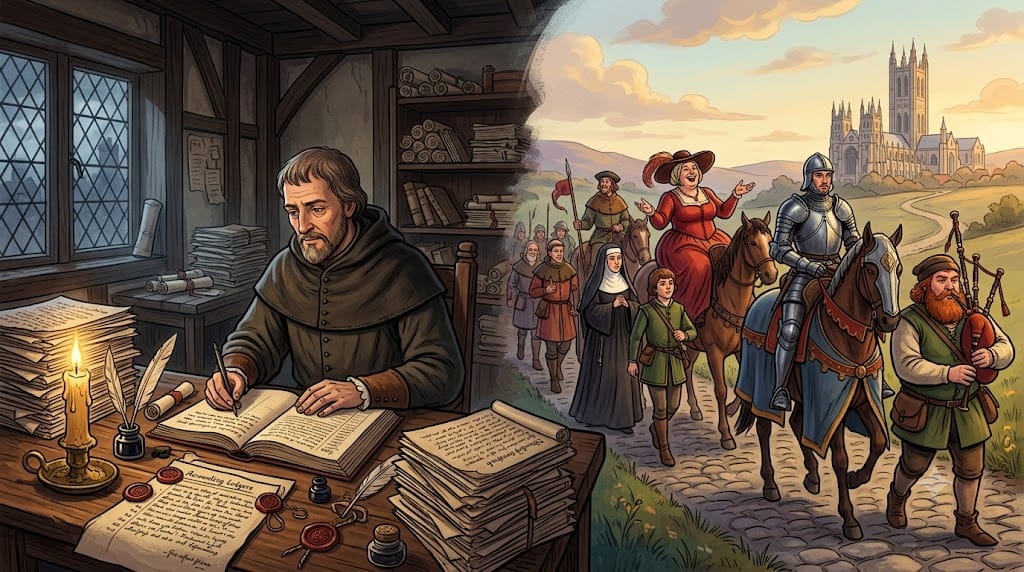
Most of us had Chaucer forced on us in school. A few bewildering lines of Middle English, something about April showers and a group of pilgrims, and then a baffled look across the classroom. But strip away the academic obligation and the life of Chaucer is one of the most genuinely gripping stories in British literary history.
Geoffrey Chaucer wasn't simply a poet. He was a soldier who got captured in France. A diplomat who traveled across medieval Europe. A customs officer managing one of the busiest ports in England. A civil servant responsible for maintaining the Tower of London. And somehow, in the gaps between all of that, he wrote the greatest work of medieval English literature and helped shape the very language you're reading right now.
Born around 1343 in London and dying in October 1400, Chaucer lived through one of the most turbulent centuries in English history — plague, war, revolt, and political upheaval — and turned it all into art. The life of Chaucer is not a quiet scholarly story. It's the account of an extraordinary man navigating an extraordinary time with intelligence, wit, and remarkable creative stamina.
So who was he? Where did he come from? And why should anyone in twenty-first century Britain care?
The World Chaucer Was Born Into: Fourteenth-Century England
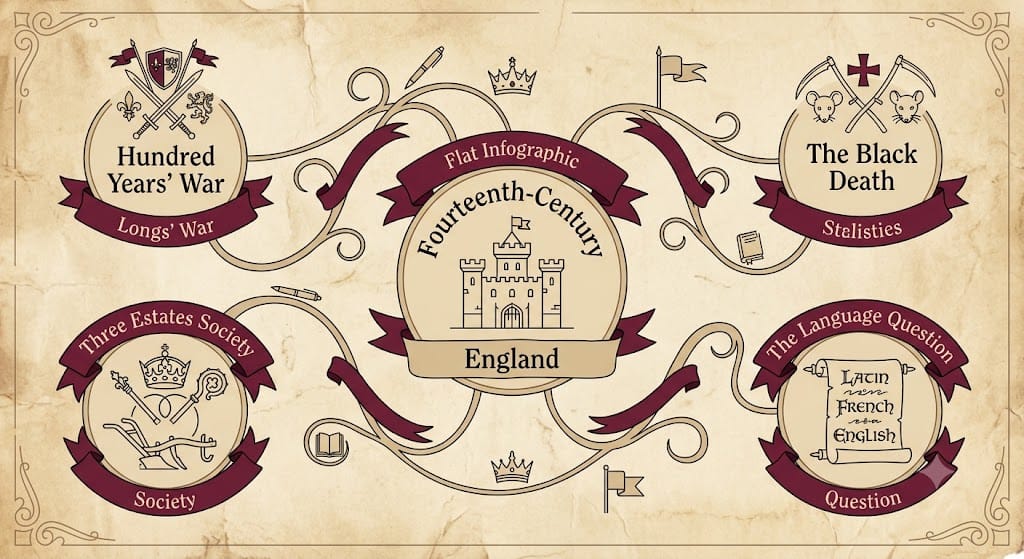
Before getting to the man himself, it's worth understanding the world he inhabited. Because the life of Chaucer only makes full sense against the backdrop of one of the most dramatic centuries England has ever seen.
A Century of War
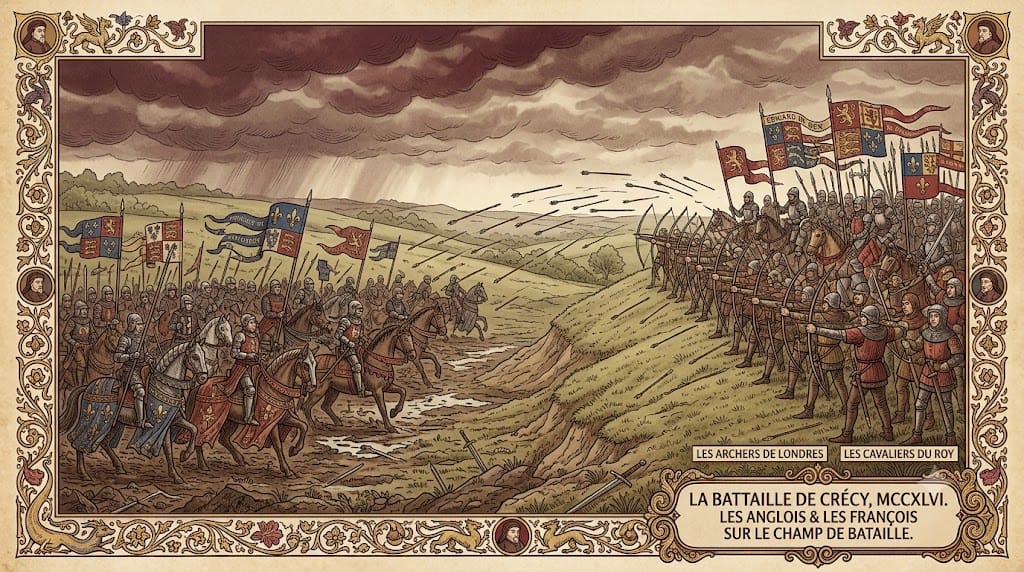
Edward III, who reigned from 1327 to 1377, was an ambitious, chivalric king who modelled himself on the Arthurian ideal. His court was one of the most splendid in Europe. He founded the Order of the Garter in 1348, patronised the arts, and pursued an aggressive foreign policy that thrust England into what became the Hundred Years' War — the prolonged dynastic and territorial conflict with France that officially began in 1337 and dragged on until 1453.
The great English victories at Crécy in 1346 and Poitiers in 1356 made England a serious military power in European affairs. Chaucer served in this war himself. He was captured. He was ransomed. The whole experience left its mark on his imagination in ways that resurface throughout his writing.
The Black Death
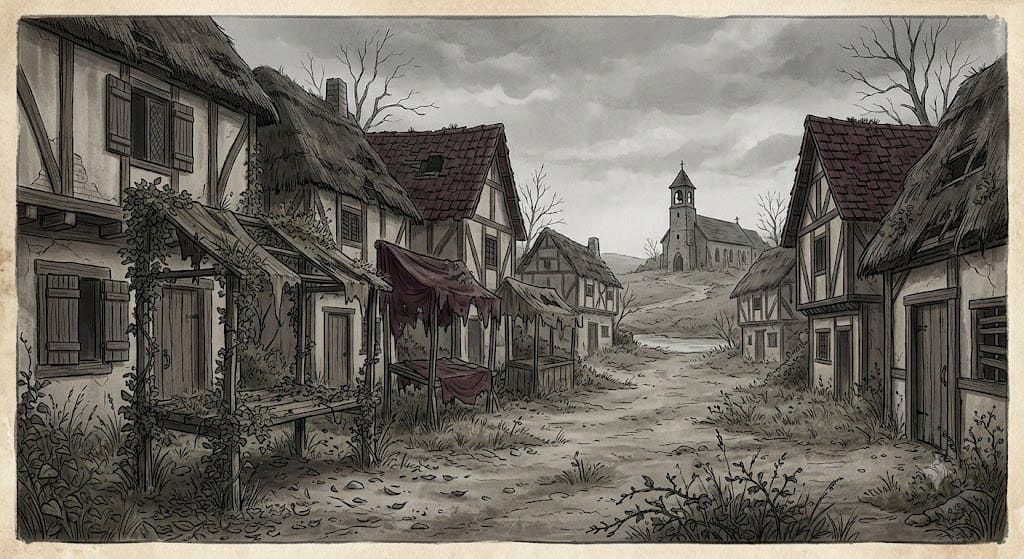
No event in the fourteenth century had more devastating consequences than the arrival of the bubonic plague in England in 1348. The Black Death killed between a third and a half of the entire English population within two years. Contemporary chroniclers described scenes of apocalyptic devastation — entire villages emptied, churches filling with the unburied dead, a widespread theological crisis as people struggled to understand why God had apparently abandoned the faithful.
Chaucer was born around 1343. He grew up in the immediate aftermath of this catastrophe. The psychological shadow of mass death is present throughout The Canterbury Tales, in its obsession with fortune, mortality, and the fragility of human happiness. The plague also paradoxically gave surviving peasants unprecedented economic bargaining power, contributing directly to the Peasants' Revolt of 1381 — which Chaucer witnessed at close quarters in London.
A World of Three Estates
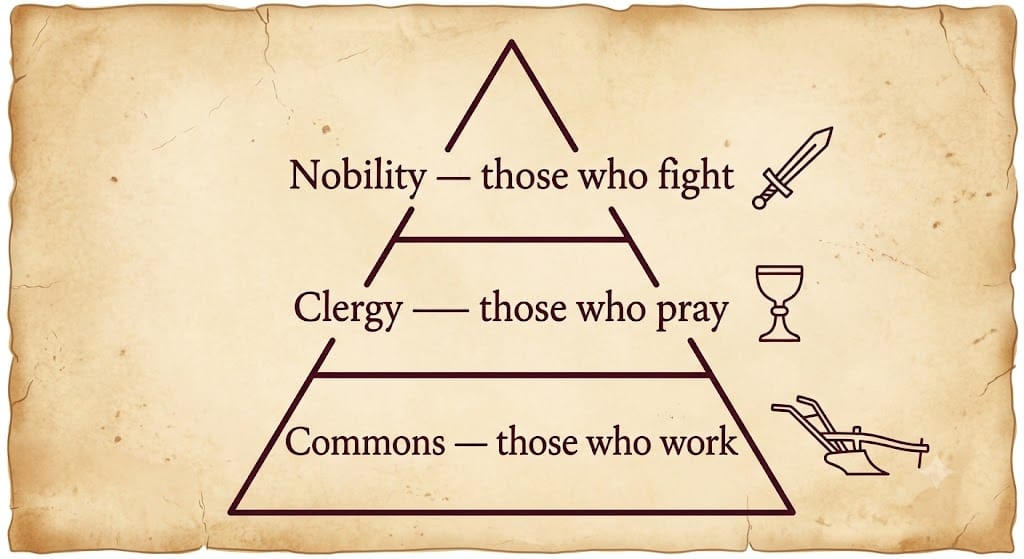
The social structure Chaucer was born into was organised according to feudal principles. At the top sat the monarch. Below came the nobility, then the clergy, then the commons — divided broadly into the merchant class and the peasantry. The theory of the Three Estates held that each group had its defined function: the nobility fought, the clergy prayed, the commons worked.
Chaucer occupied a genuinely interesting and ambiguous position within this structure. His father was a prosperous London wine merchant — comfortably wealthy but not noble. His entry into royal service placed him between the aristocratic world he served and the commercial world from which he came. That in-between position, that doubled perspective, gave him the material and the distance to write about every level of society with equal sharpness and sympathy.
The Language Question
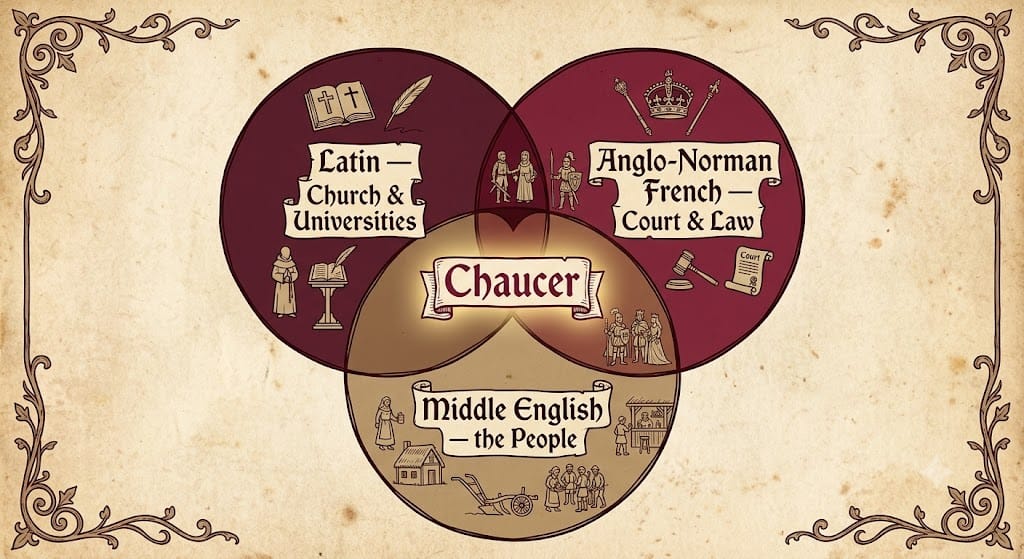
The linguistic landscape of fourteenth-century England was surprisingly complex. Latin served the Church and the universities. Anglo-Norman French served the aristocracy and the law courts. Middle English — in numerous regional dialects — served the majority of the population. The Statute of Pleadings in 1362 required court proceedings to be conducted in English, acknowledging that even the aristocracy had largely stopped using French as a first language.
Chaucer's consistent choice to write in the London dialect of Middle English, and the enormous prestige his work conferred on that dialect, contributed decisively to the eventual triumph of the London standard as the basis of written English. He didn't just write in English. He elevated it.
Birth, Family, and Early Life
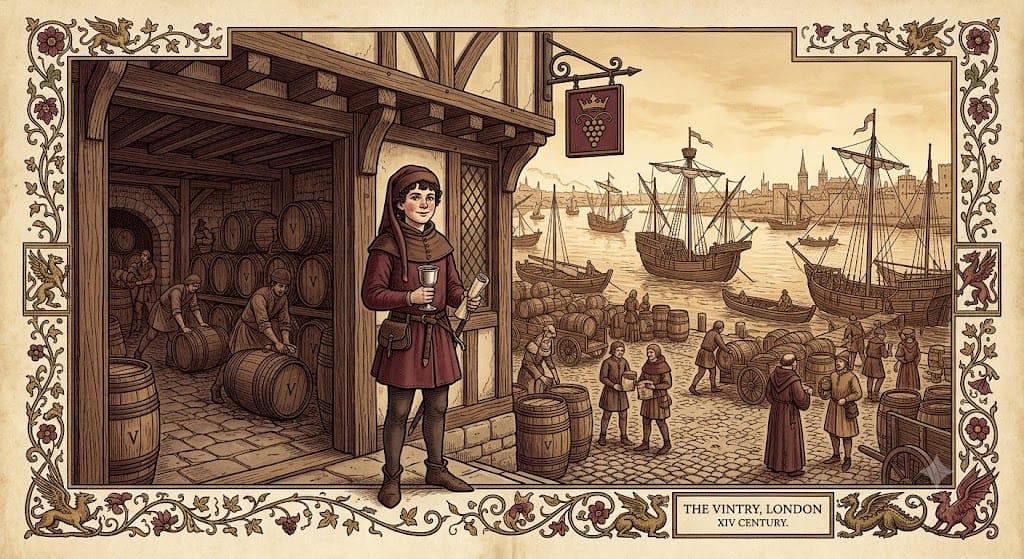
Geoffrey Chaucer was born in London, almost certainly in the early 1340s. The best scholarly estimate places his birth around 1343, based on a legal deposition from 1386 in which he stated he was "forty years and more" of age. He was born in the parish of St. Martin in the Vintry — a neighbourhood in the south of the city associated with the wine trade, where his family had lived for at least two generations.
His father, John Chaucer, was a prosperous wine merchant who also served as a deputy to the king's butler. His mother, Agnes de Copton, came from a family with connections to the same trade. The Chaucers were not noble, but they were solidly and comfortably placed within the growing merchant class — wealthy enough to provide Geoffrey with an education and to secure for him a position in a royal household, but not of the aristocratic class that inherited literary culture as a birthright.
The earliest documentary evidence placing Chaucer directly is a household account from 1357 recording the purchase of a livery for "Galfridus Chaucer" — identifying him as a page in the household of Elizabeth de Burgh, Countess of Ulster, wife of Prince Lionel, second son of King Edward III. He was fourteen or so. Already old enough for royal service. Already deemed suitable for one of the most cultivated and prestigious households in England.
The education he received combined academic and practical elements. He learned to read and write in English, Latin, and French. His later works demonstrate extraordinarily wide reading — Virgil, Ovid, Cicero, Boethius from the Latin tradition; Guillaume de Machaut and the Roman de la Rose from the French; and the great Italian writers of the Trecento. The practical education of a royal page — court protocols, horsemanship, hunting, the rituals of aristocratic sociability — gave him equally deep knowledge of the cultural world he would later depict with such precision.
His facility in multiple languages deserves particular emphasis. Latin, French, Italian, and his native English made him one of the most linguistically accomplished writers of the age. That multilingualism wasn't merely a scholarly achievement. It was the enabling condition of his creative originality — allowing him to synthesise materials from widely different literary traditions into something distinctively and powerfully his own.
Service in the Royal Court: The Career That Made His Writing Possible
The central organising fact of Chaucer's adult life was his service to the English crown, which lasted in various forms for nearly four decades. Beginning as a page around 1357, he rose through the ranks to become one of the most trusted and versatile servants of both Edward III and Richard II.
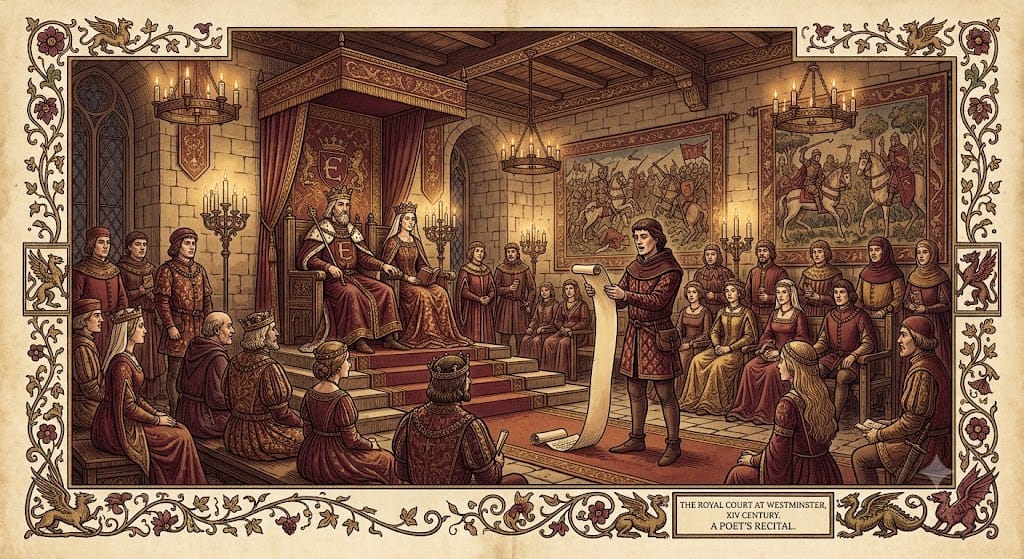
By around 1360, he had transferred to the king's household. By the late 1360s, royal documents describe him as an "esquire of the king's household" — responsible for ceremonial attendance, carrying royal messages, and, as his reputation grew, composing and performing poetry for the court's entertainment.
The court of Edward III was a genuine centre of literary and artistic patronage. It reflected the king's cultivation of a chivalric image in the Arthurian tradition. For a young man of Chaucer's gifts, service in this environment was both a practical necessity and an incomparable education in everything from statecraft to storytelling.
After Edward III's death in 1377, Chaucer continued in royal service under Richard II — himself one of the most aesthetically minded of medieval English monarchs. Richard's turbulent reign provided a backdrop of dramatic political tension: the Peasants' Revolt of 1381, the conflicts with the Lords Appellant, and the king's eventual deposition in 1399. Chaucer watched all of it from close quarters. None of it appears directly in his poetry. All of it shapes it.
The Military Years and the Italian Journeys That Changed Everything
Captured in France
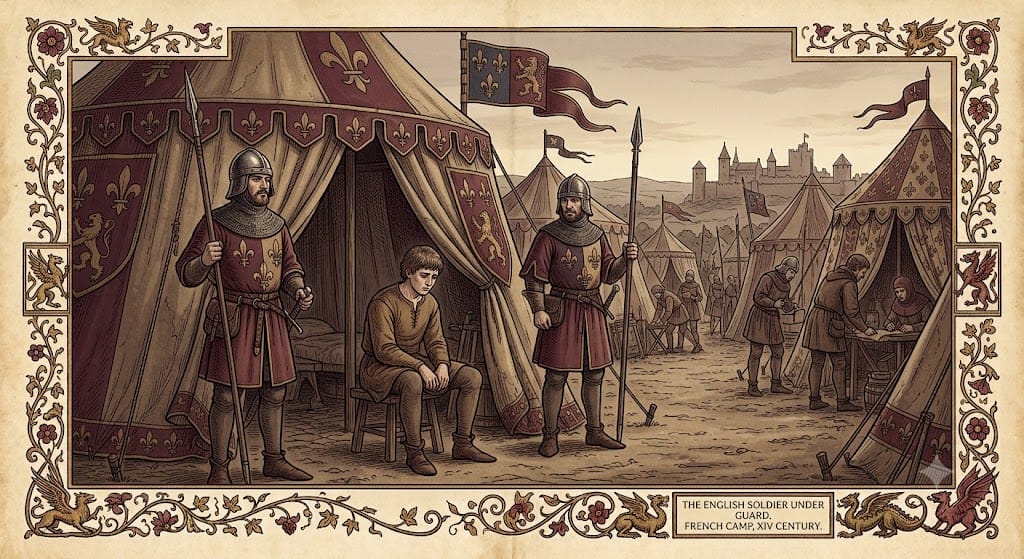
In 1359, Chaucer served in the English military campaign in France — one of the most ambitious operations of the Hundred Years' War, involving a large English force marching through the heart of France to bring the French king to battle. The campaign ultimately failed and ended with the Treaty of Brétigny in 1360.
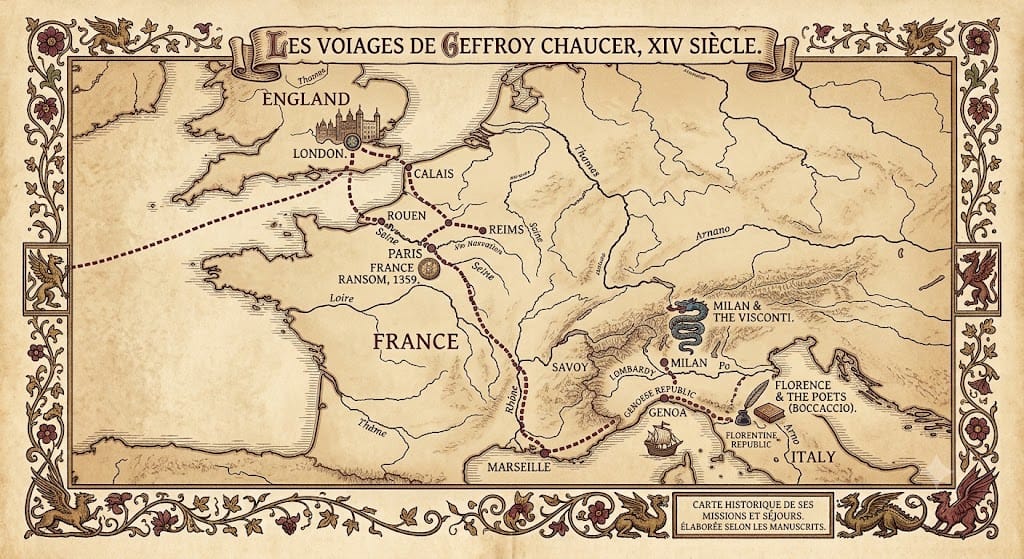
During this campaign, Chaucer was captured by French forces. The documentary record is precise: in March 1360, Edward III contributed sixteen pounds toward his ransom — comparable to sums paid for other esquires of similar standing. The experience of capture, imprisonment, and the arbitrary reversals of fortune left its mark on his creative imagination. Themes of confinement, freedom, and Fortune's wheel recur throughout his poetry in ways that feel personal rather than merely conventional.
Italy: The Turning Point
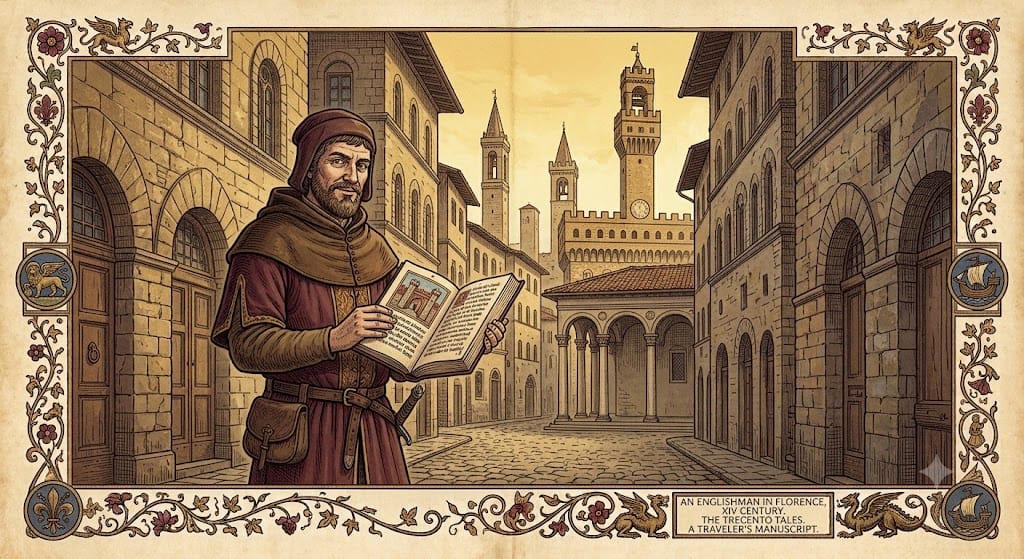
Far more transformative than the military experience were Chaucer's two known visits to Italy. In 1372–73 he traveled to Genoa on a diplomatic mission concerning English trading privileges, and also to Florence. In 1378 he returned to Italy on a mission to the court of Bernabò Visconti in Milan.
The significance of these Italian journeys for English literary history is almost impossible to overstate. Italy in the 1370s stood at the height of the Trecento literary renaissance — the great flowering associated with Dante Alighieri (1265–1321), Francesco Petrarch (1304–1374), and Giovanni Boccaccio (1313–1375). Whether Chaucer met any of them in person is disputed; he cannot have met Boccaccio on the second visit, since Boccaccio died in 1375.
What is beyond doubt is that Chaucer came into direct contact with the works of all three masters, and that this contact fundamentally transformed his literary ambitions. From Dante he learned the possibilities of vernacular philosophical poetry. From Petrarch, the tradition of elevated love lyric. And from Boccaccio — particularly the Filostrato and the Decameron — the narrative models that would eventually become Troilus and Criseyde and The Canterbury Tales.
Italy showed Chaucer what English literature could become. He spent the rest of his career making it so.
Government Service: The Man Behind the Customs Ledger
Controller of Customs
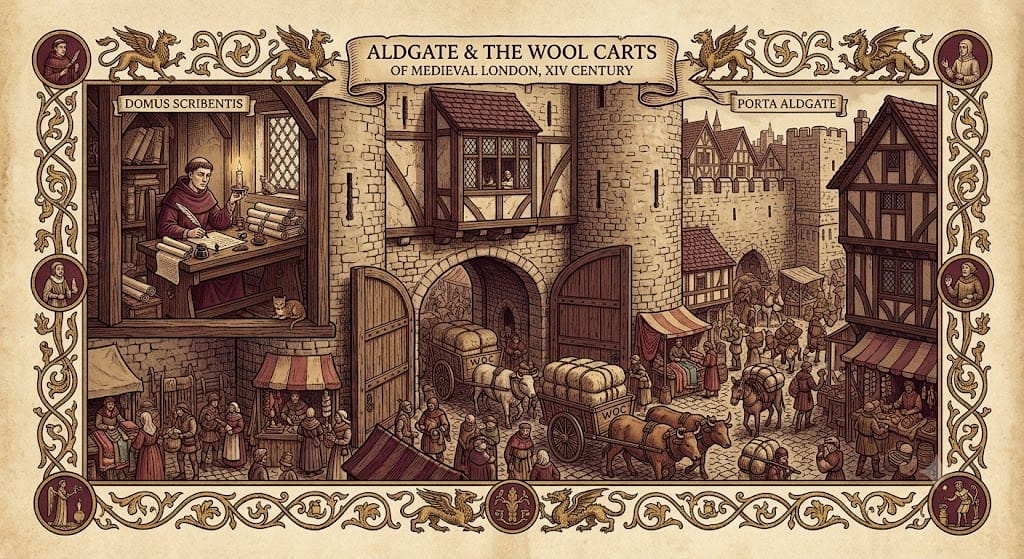
In 1374, Chaucer was appointed Controller of Customs and Subsidy of Wools, Hides, and Woolfells in the port of London — one of the most important administrative positions available to someone of his rank. He held this post until 1386, overseeing the collection of customs duties on the wool trade, England's most valuable export. In 1382, an additional role was added: Controller of the Petty Custom on wines.
These posts gave him substantial income, placed him at the heart of London's commercial and administrative life, and provided ample opportunity to observe the extraordinary range of social types who passed through the port of London — merchants, sailors, clergy, craftsmen, travellers. This observational richness fed directly into the social panorama of The Canterbury Tales.
He also received a rent-free dwelling above the Aldgate, one of the main gates into the city. The image of Chaucer sitting above the gate, watching London pass below him whilst working on his poems in the evenings, has a pleasing vividness to it — though whether it's entirely accurate is another matter.
Clerk of the King's Works
In 1389, Richard II appointed Chaucer Clerk of the King's Works — responsible for the maintenance and construction of royal buildings including the Tower of London, Westminster Palace, and various royal manor houses. The post carried substantial salary and responsibility, involving the management of large numbers of craftsmen and labourers.
In 1390, he was robbed of royal funds on at least three occasions whilst traveling on official business. This was not an uncommon hazard for royal officials moving through the English countryside, but it was clearly a considerable inconvenience. He left the position in 1391 and subsequently served as deputy forester of North Petherton in Somerset — a much quieter role that offered modest income and, more valuably, time to write.
Marriage, Family, and Personal Life
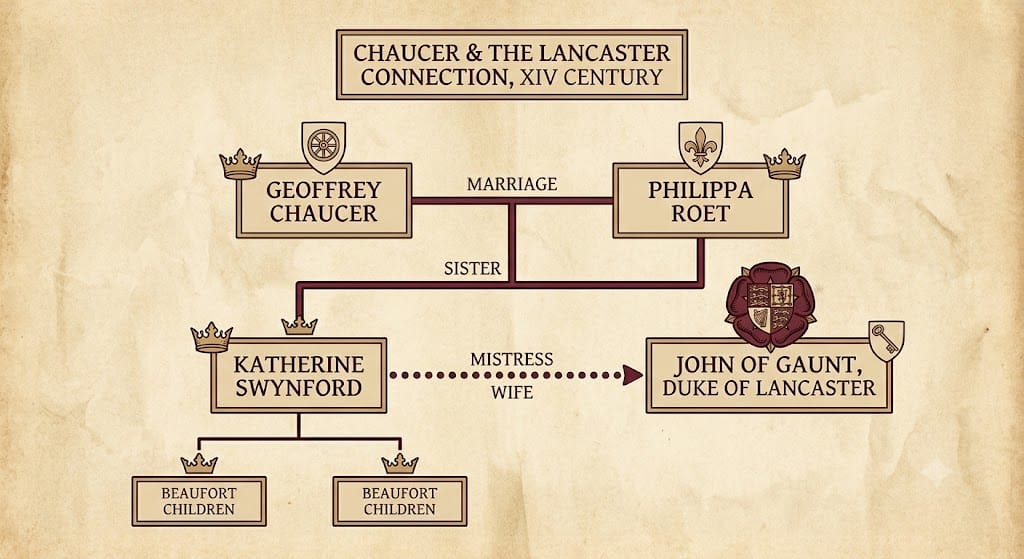
Chaucer married Philippa Roet, daughter of the Flemish knight Sir Paon de Roet, probably around 1366. Philippa was a lady-in-waiting first to Queen Philippa of Edward III, then to Blanche of Lancaster, then to Katherine Swynford. The marriage was significant not only personally but in terms of Chaucer's remarkable social connections.
Philippa's sister Katherine Swynford became the longtime mistress and eventually third wife of John of Gaunt, Duke of Lancaster — the most powerful magnate in England. This connection made Chaucer the brother-in-law of the Duke's consort. He was, in other words, one degree of separation from the most powerful man in the kingdom outside the king himself.
Chaucer and Philippa had at least two children who survived to adulthood: Thomas Chaucer, who rose to prominence as a diplomat and politician, and Elizabeth Chaucer, who became a nun at Barking Abbey. Philippa died around 1387.
There is one biographical episode that continues to attract scholarly attention and controversy. A document of May 1380 records that a woman named Cecilia Chaumpaigne released Chaucer from all actions including one described as "de raptu meo." The precise meaning of this Latin phrase — and what the underlying events actually were — has been debated by scholars for decades, and was reignited by new archival discoveries in 2022. It remains unresolved and continues to generate serious scholarly debate about both Chaucer's biography and his literary representations of gender.
The Major Works: A Guide Through Chaucer's Literary Career
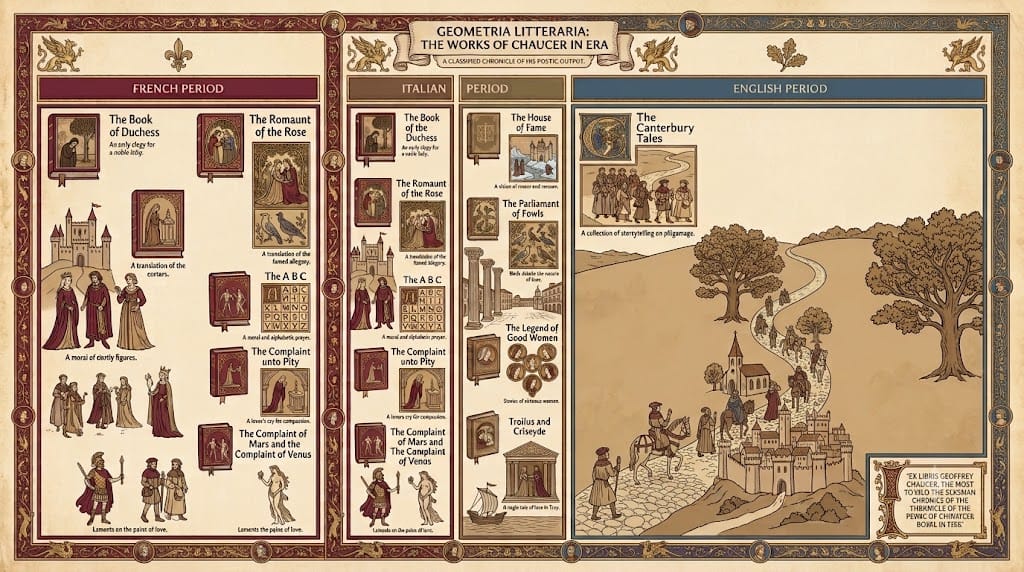
Chaucer's literary career is conventionally divided into three phases — French, Italian, and English — reflecting the dominant influences of each period.
The French Period: Dream Visions and Courtly Love
The Book of the Duchess (c. 1368–1374) is Chaucer's earliest substantial surviving poem — an elegy composed in honour of Blanche of Lancaster, the first wife of John of Gaunt, who died of plague in September 1368. The poem takes the form of a dream vision in which a sleepless narrator encounters a young knight in black, mourning his lost lady. The narrator's apparent obtuseness — his repeated failure to understand that the knight is mourning death rather than rejection — is usually interpreted as a therapeutic strategy, gently compelling the grieving knight to articulate his loss. It demonstrates Chaucer's thorough absorption of French literary models, particularly the work of Guillaume de Machaut, whilst already deploying his characteristic dramatic narrator.
The Romaunt of the Rose (date disputed, likely early in Chaucer's career) is a partial English translation of the great French allegorical poem Le Roman de la Rose, begun by Guillaume de Lorris and completed by Jean de Meun. Only a fragment survives that can be confidently attributed to Chaucer, but the translation itself was formative: it steeped him in the conventions of allegorical dream vision, courtly love psychology, and the personified abstractions (Love, Jealousy, Reason) that would recur throughout his later work. Whatever its precise authorship history, it represents the deepest single channel through which French courtly poetics entered Chaucer's imagination.
The A B C is a devotional poem in praise of the Virgin Mary, its twenty-three stanzas each beginning with a successive letter of the alphabet — a structural conceit adapted from a French original by Guillaume de Deguileville. It is Chaucer's most straightforwardly pious surviving work, notable less for innovation than for the technical control it already shows: intricate stanza forms handled with an ease that points toward the metrical confidence of his mature poetry.
The Complaint unto Pity is a shorter lyric in the tradition of the courtly "complaint" — a poem in which the speaker laments the death or unattainability of an allegorical figure, here Pity herself, who has died and left Cruelty in command of the beloved's heart. It's a slight piece next to Chaucer's later work, but it shows him experimenting early with rhyme royal, the seven-line stanza he would later use to devastating effect in Troilus and Criseyde.
The Complaint of Mars and The Complaint of Venus are a linked pair of poems built around the illicit, astronomically-framed love affair between the two planetary deities. The first narrates their brief union and forced separation in vivid, almost narrative terms; the second, a much closer adaptation of a French poem by Oton de Graunson, is spoken in Venus's voice and dwells on the anxieties of love under the threat of gossip and jealous rivals. Together they demonstrate Chaucer's fluency in the astrological and mythological ornament fashionable at the French-influenced English court, and his growing skill at inhabiting a female speaking voice — a skill that would matter enormously later.
The Italian Period: Ambition and Psychological Depth
The House of Fame (c. 1374–1385) is a more experimental dream vision, divided into three books. The narrator is carried through the heavens in the talons of a golden eagle (borrowed from Dante's Purgatorio) to the House of Fame, where the goddess Fame distributes reputation with capricious arbitrariness. The poem is unfinished and its ultimate purpose remains debated. What is clear is that it shows Chaucer moving toward a more intellectually adventurous poetry, drawing on Dante as a model for supernatural journey narrative.
The Parliament of Fowls (c. 1380–1382) is a dream vision of approximately 700 lines, probably written for a specific courtly occasion — most likely Valentine's Day, which the poem is among the earliest texts to associate with romantic love. The narrator is transported to a garden of love and an assembly of all the birds of the world, gathered to choose their mates. The debate among birds over who shall win the eagle hen provides extended comic exploration of different perspectives on love: the elevated idealism of the noble birds contrasted with the earthy pragmatism of the lower species. It anticipates in miniature the great multiperspectival structure of The Canterbury Tales.
Troilus and Criseyde (c. 1382–1387) is widely regarded as Chaucer's greatest single work and one of the supreme achievements of medieval European literature. This narrative poem of approximately 8,239 lines tells the story of the Trojan warrior Troilus and his doomed love for the widow Criseyde — based on Boccaccio's Filostrato, but so fundamentally transformed that comparison reveals the full extent of Chaucer's creative power. The poem explores joy and tragedy against a Boethian philosophical framework raising questions about fate, free will, and divine providence.
The characterisation is extraordinary. Troilus is a deeply sympathetic portrait of a man overwhelmed by love, rendered with both tenderness and irony. Criseyde — who yields to Troilus under the management of her uncle Pandarus, then to the Greek Diomede after being exchanged to the enemy camp — is one of the most complex and contested female characters in all of medieval literature. She is capable, pragmatic, vulnerable, and ultimately unfaithful, yet presented with such understanding that simple condemnation is impossible. Pandarus, the genial and morally ambiguous go-between, is a comic creation of the highest order who also raises profound questions about the ethics of friendship.
The Legend of Good Women (c. 1386–1388) survives in two versions of its Prologue and nine completed legends drawn from classical mythology. Chaucer presents himself as being arraigned before the god of Love for offending women through his writings, and sentenced to write legends of faithful women as penance. The legends retell stories of Cleopatra, Thisbe, Dido, and others. The Prologue contains some of his most beautiful lyric verse. The poem was left incomplete — Chaucer apparently lost interest in the project, and it is easy to see why, given what he was moving toward.
The English Period: The Canterbury Tales
The Canterbury Tales (c. 1387–1400) is Chaucer's masterwork and the greatest achievement of medieval English literature. Left unfinished at his death, it nonetheless represents a feat of literary organisation, social observation, psychological characterisation, and narrative skill unequalled in English before Shakespeare. The work as Chaucer left it contains approximately 17,000 lines and twenty-four tales told by a company of pilgrims travelling from London to the shrine of Thomas Becket at Canterbury Cathedral.
The genius lies not merely in the quality of the individual tales but in the architectural conception holding them together. By using the varied social composition of a pilgrimage group, Chaucer created a dramatic context in which different social types tell stories reflecting their characters and worldviews — generating a continuously evolving conversation about life, society, morality, and literature itself.
The Canterbury Tales: A Closer Look
The Frame and the General Prologue
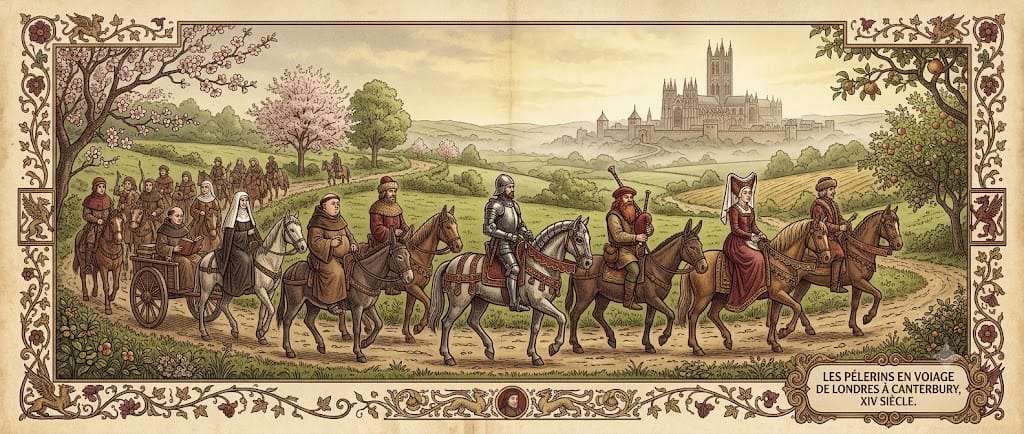
The genesis of The Canterbury Tales is usually traced to Chaucer's encounter with Boccaccio's Decameron, in which ten young Florentines who have fled the Black Death tell each other stories. Chaucer transformed this model crucially. Where Boccaccio's narrators are a socially homogeneous, aristocratic group, Chaucer's pilgrims span virtually the entire social spectrum of medieval England. Where Boccaccio's setting is artificial, Chaucer's is the actual road from London to Canterbury. And where Boccaccio's tales are largely told in a consistent narrative voice, Chaucer's are dramatically individualised — each reflecting the character, class, and concerns of its teller.
The General Prologue, which introduces the pilgrims through portrait-sketches, is one of the greatest pieces of descriptive writing in English literature. Beginning with the famous spring opening — "Whan that Aprill with his shoures soote / The droghte of March hath perced to the roote" — it introduces twenty-nine pilgrims through descriptions that combine physical detail, social observation, and psychological characterisation with extraordinary economy and wit.
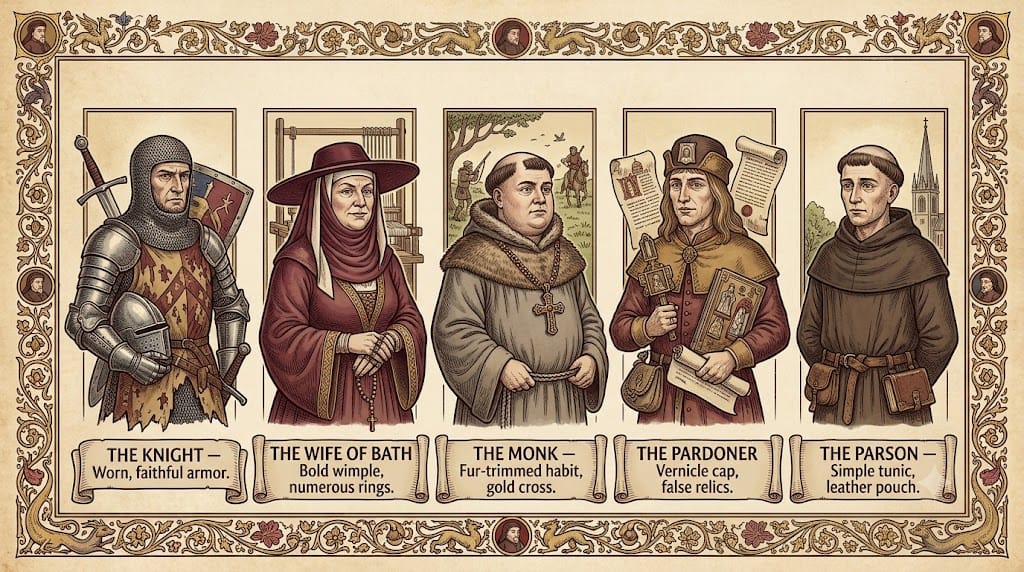
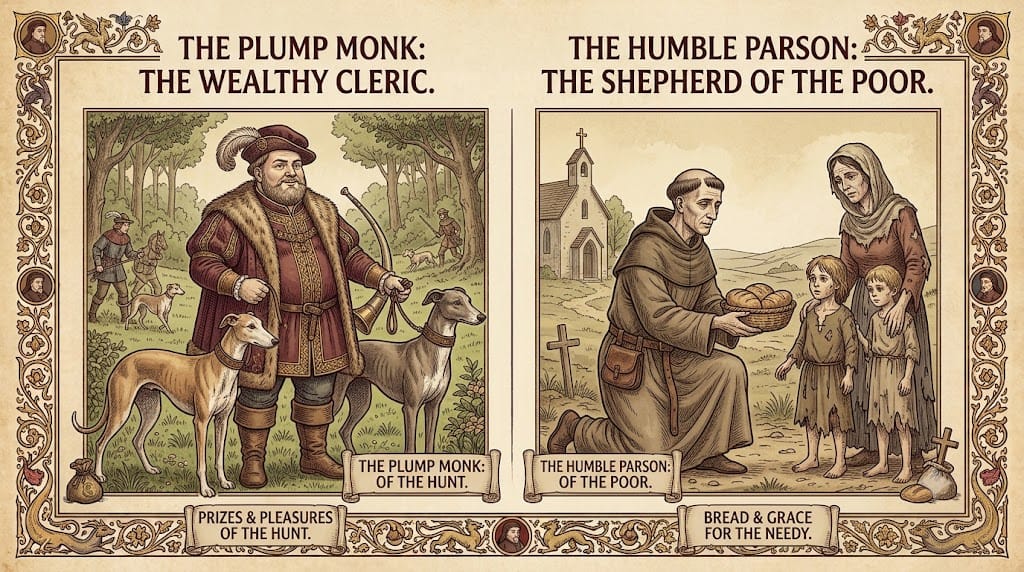
The range is remarkable. The idealised Knight; the hypocritical Monk who neglects his monastic duties; the seductive Friar who uses confession for personal gain; the corrupt Pardoner who sells fake relics; the unforgettable Wife of Bath, whose five marriages and experience-based philosophy make her one of the most vivid characters in all of literature and many others.
Social Satire and the Role of the Church
One of the most striking aspects of The Canterbury Tales is the sharpness and comprehensiveness of its social criticism. Chaucer surveys the estates of medieval society and finds in each both virtue and corruption. The corruption of the Church is a particular focus: the Summoner and Pardoner who abuse ecclesiastical offices for personal gain; the Monk who prioritises hunting over prayer; the Friar who exploits the poor.
Yet Chaucer's satire operates through irony rather than direct didactic attack. The narrator of the General Prologue consistently praises figures who are clearly corrupt, requiring the reader to recognise the gap between what is said and what is meant. This deployment of dramatic irony — one of Chaucer's most distinctive contributions to English fiction — requires an active, intelligent reader. It was deliberately designed to produce one.
Against the corrupted clergy, Chaucer sets the Parson — a model of genuine pastoral virtue, sincerely and warmly depicted. The contrast is never stated directly. It doesn't need to be.
The Range of Tone: From High Tragedy to Outrageous Comedy
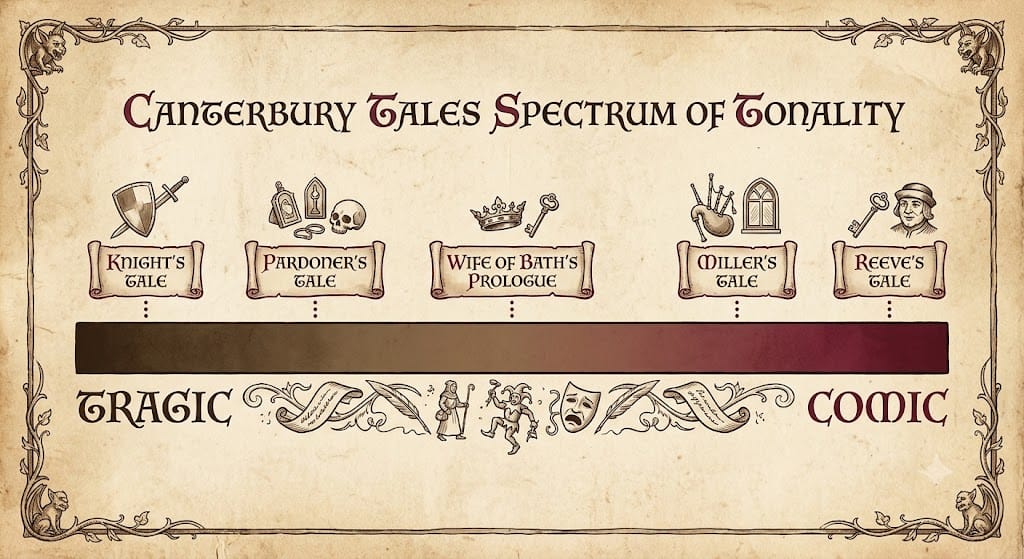
The Canterbury Tales encompasses an extraordinary range — from the courtly gravity of the Knight's Tale to the scatological comedy of the Miller's Tale and the Reeve's Tale, from the moral seriousness of the Pardoner's Tale to the feminist self-advocacy of the Wife of Bath's Prologue.
The Miller's Tale — in which a clever Oxford student seduces a carpenter's wife and an elaborate farcical deception ensues — is one of the funniest and most perfectly constructed comic narratives in any language. It is also very far from polite. Chaucer inherited the French tradition of bawdy short narrative, the fabliau, and deployed it with obvious personal relish.
The Wife of Bath's Prologue is perhaps the most celebrated single piece in the whole work. She delivers a raucous, brilliant, experience-based defence of marriage and female autonomy, arguing from her own five marriages against the clerical tradition of female subordination. She is funny, defiant, vulnerable, and impossible to reduce to a simple moral verdict. Scholars have argued about her for six hundred years and show no signs of stopping.
Chaucer's Language and What He Did to English
Chaucer wrote in Middle English — the East Midland dialect of London, the most socially prestigious form of the language in the fourteenth century and the one from which Modern Standard English most directly descends. His consistent use of this dialect, and the prestige his work conferred on it, contributed significantly to the eventual triumph of the London standard as the basis of written English.
He was the first major English poet to write sustained narrative poetry in iambic pentameter — the five-stress decasyllabic line that would become the dominant metre of English poetry for the next five centuries. The heroic couplet and the rhyme royal stanza, both used extensively by Chaucer, had distinguished literary histories extending forward to Dryden, Pope, and Shakespeare.
His most important narrative innovation was the development of the dramatic narrator — a fictional first-person persona whose apparent simplicity or naivety creates an ironic distance between what is said and what is meant. This allows Chaucer to say one thing and mean another, to engage the reader in active interpretive labour, and to avoid the didactic directness that was the more conventional mode of medieval narrative.
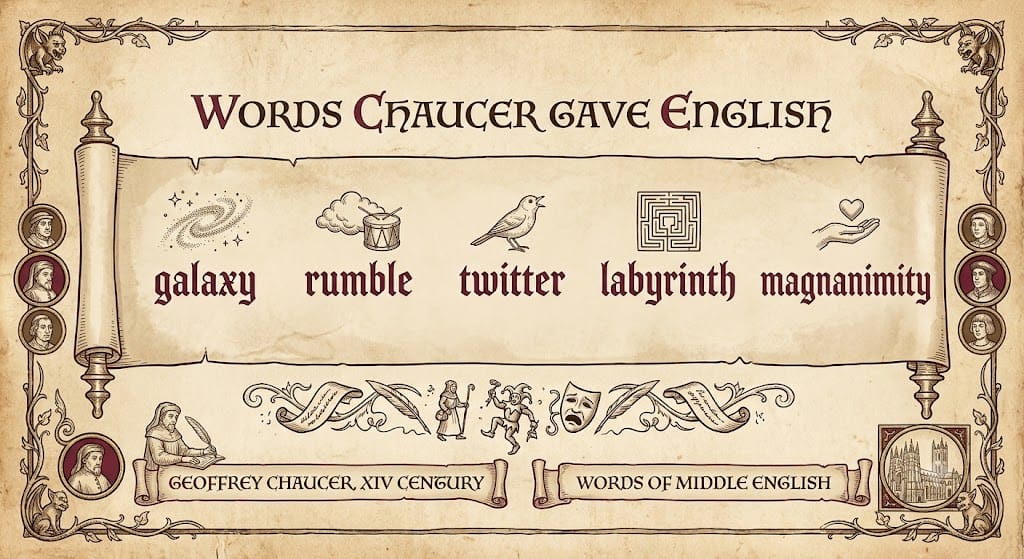
His contribution to vocabulary was equally substantial. He introduced hundreds of words from Latin, French, and Italian — "galaxy," "rumble," "twitter," "labyrinth," "magnanimity," and many others — that have since become permanent features of the language. The next time you use the word "twitter," you are, in a very small and indirect way, using a word that Geoffrey Chaucer brought into English.
Philosophical and Religious Thought
Chaucer's relationship to the religious and philosophical culture of his age was complex and cannot be reduced to simple piety or simple scepticism. He engaged deeply with philosophical questions raised by Christian theology — about fate, free will, divine providence, and the nature of virtue — whilst maintaining an ironic and sometimes satirical attitude toward the institutional Church and its representatives.
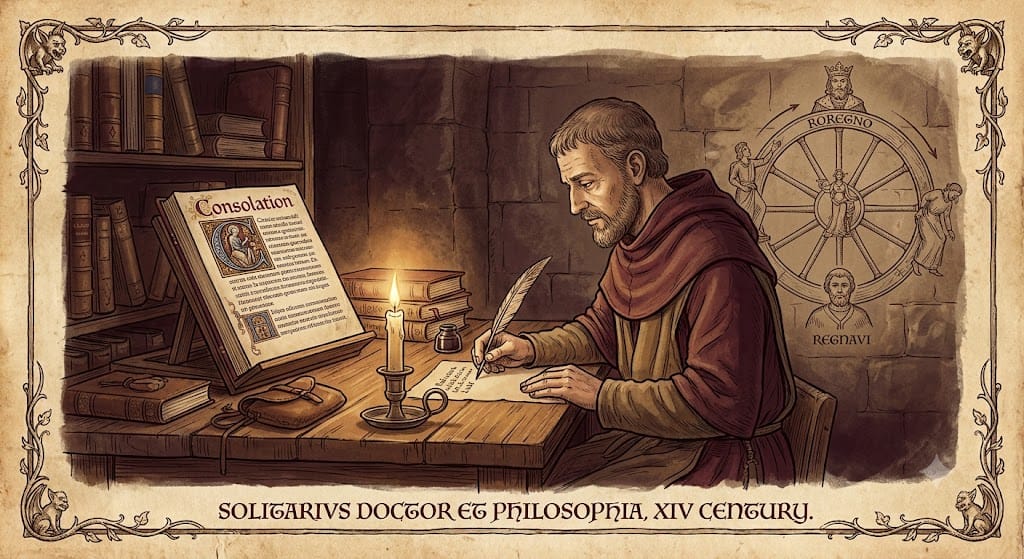
The philosophical framework that most deeply shaped his thinking was Boethian. The Consolation of Philosophy, written by Boethius in 524 CE whilst awaiting execution, addresses why good people suffer, why the wicked prosper, what constitutes true happiness, and how we should understand the relationship between divine providence and human free will. These questions run through Chaucer's greatest works like a philosophical bass line. He translated the Consolation into English — a major undertaking — and its influence is felt throughout Troilus and Criseyde and The Knight's Tale.
The debate about marriage, celibacy, and the authority of experience versus scripture — most powerfully expressed in the Wife of Bath's Prologue — draws on a rich tradition of patristic and scholastic thought. Chaucer dramatises competing philosophical and theological positions without imposing a single resolution. That refusal to settle the argument is one of the most characteristic and sophisticated features of The Canterbury Tales. He trusted his readers to think for themselves.
Final Years, Death, and the Beginning of a Legacy
The final decade of Chaucer's life, from roughly 1390 to 1400, was a period of relative financial difficulty. After leaving the Clerkship of the King's Works in 1391, he spent several years as deputy forester of North Petherton in Somerset — removed from London's centre of gravity. The literary evidence suggests he continued working on The Canterbury Tales throughout this period.
In 1399, the political landscape shifted dramatically. Henry Bolingbroke — John of Gaunt's son, and therefore Chaucer's nephew by marriage — returned from exile, deposed Richard II, and became Henry IV. In December 1399, Henry confirmed and increased Chaucer's royal annuity. Chaucer also leased a house in the garden of Westminster Abbey — presumably intending to spend his final years in comfortable proximity to the court and to London's cultural life.
His last poem was almost certainly The Complaint of Chaucer to His Purse — a playful petition to the new king to restore his financial support, treating his empty purse as a faithless lover. Its lightness of touch suggests that even in financial difficulty and advancing age, his literary gifts remained entirely undimmed.
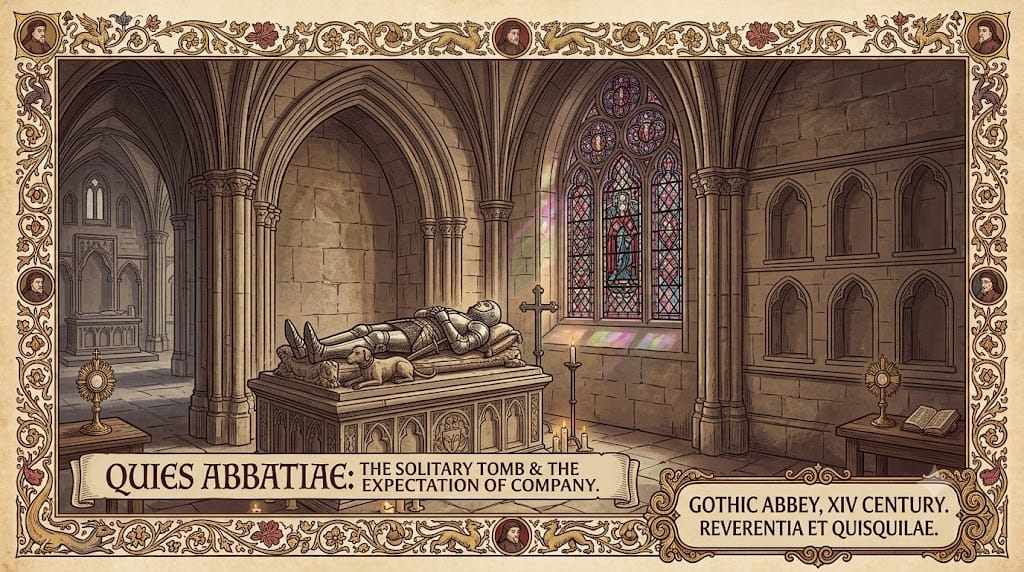
Geoffrey Chaucer died on 25 October 1400. He was buried in Westminster Abbey, in the south transept — an honour normally reserved for royalty, the highest nobility, and senior ecclesiastics. The date of his death is known from a contemporary inscription on his tomb. The tomb now marking his burial place was erected in 1556 by Nicholas Brigham, a poet and Chaucer enthusiast, more than a century and a half after the poet's death.
The area of Westminster Abbey where Chaucer was buried has since become known as Poets' Corner, as subsequent generations of poets beginning with Edmund Spenser in 1599 chose to be buried near the great father of English literature. Poets' Corner now contains the tombs or commemorative monuments of scores of the greatest names in English literature — Spenser, Dryden, Samuel Johnson, Keats, Shelley, Byron, and many others. It exists because of Chaucer. Because someone decided, for the first time, that a creative writer deserved burial in the national shrine.
That decision made a claim for the dignity and importance of literature that has never since been revoked.
Chaucer's Legacy: What He Left Behind
The influence of Chaucer on subsequent English literature is so pervasive and deep that it is difficult to summarise without risking understatement.
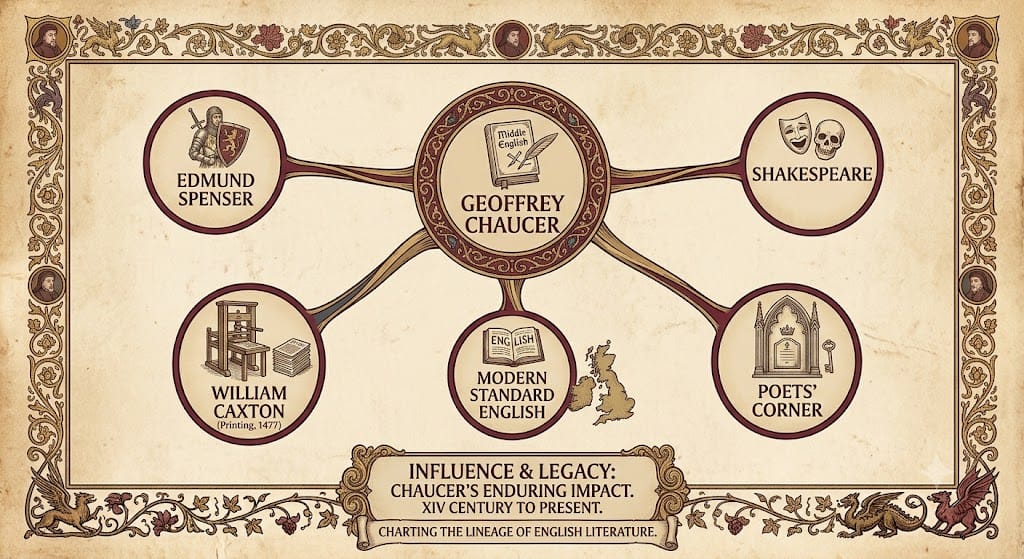
The first generation of English poets after Chaucer — including John Lydgate and Thomas Hoccleve, who knew him personally — explicitly acknowledged him as their master. Hoccleve produced a memorial tribute containing what may be the only surviving portrait of the poet from his lifetime. By the mid-fifteenth century, acknowledging Chaucer as the father of English poetry had become a literary commonplace.
Edmund Spenser called him "the well of English undefiled." Shakespeare knew Chaucer's work and drew on it directly — Troilus and Criseyde for his own Troilus and Cressida; The Knight's Tale for A Midsummer Night's Dream and The Two Noble Kinsmen. William Caxton printed the first edition of The Canterbury Tales in 1477, beginning Chaucer's print afterlife and ensuring his work reached far beyond the manuscript copies that had circulated during his lifetime.
Contemporary scholarship continues to engage with Chaucer across a remarkably wide range of critical approaches. Feminist critics have examined his complex representations of gender, particularly in Criseyde and the Wife of Bath. New historicist critics examine the ways his poetry engages with the specific social, economic, and political conditions of late fourteenth-century England. Digital humanities projects have produced new editions and enabled new forms of textual analysis. In 2022, new archival evidence recontextualised the long-debated Cecilia Chaumpaigne document — demonstrating that our understanding of both his life and his work remains genuinely open to revision.
Chaucer continues to be read and studied in the twenty-first century for reasons that transcend historical importance. His characters are too vivid, his comedy too sharp, his pathos too genuine, and his intelligence too wide-ranging for his work to become the exclusive preserve of academic study. The Wife of Bath speaks to contemporary readers with an immediacy that no cultural change has diminished. The Pardoner's magnificent confession of his own hypocrisy raises questions about virtue, sincerity, and performance that remain as urgent now as they were in 1390.
Common Myths About Chaucer Worth Setting Straight
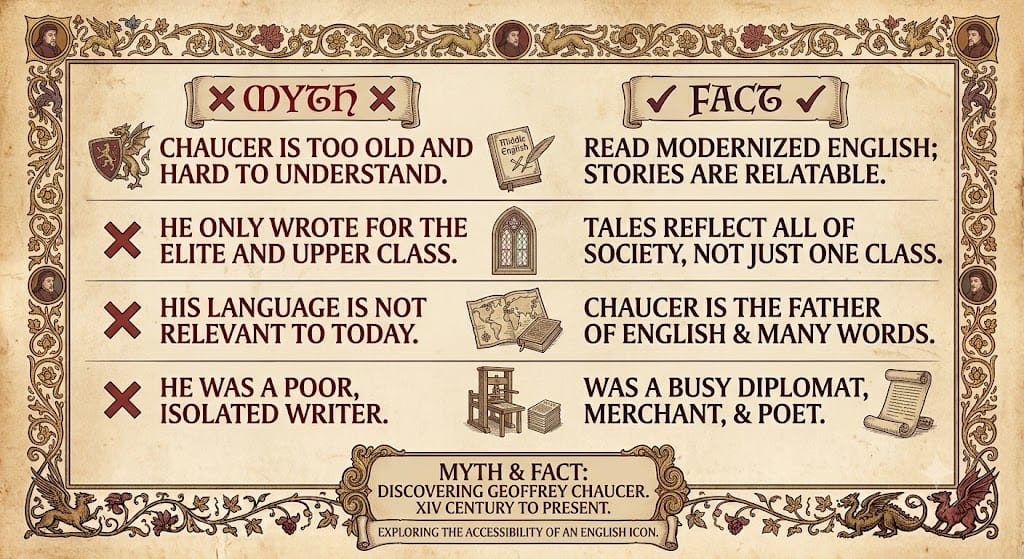
Myth: Chaucer is too difficult for ordinary readers. This one persists because schools have a habit of presenting him badly. The truth is that The Canterbury Tales is frequently very funny — bawdy, sharp, and full of characters who feel immediately recognisable. The Miller's Tale is one of the funniest short narratives in any language. It is also very much not suitable for younger children, which is precisely why schools tend to avoid it. The difficulty is often overstated and easily overcome with a decent modern translation alongside the original.
Myth: He was purely a court poet writing for the elite. The life of Chaucer is actually the story of a man who moved between worlds with unusual ease. Yes, he served at court and wrote for royal patrons. But his mother tongue was the commercial, everyday London of his father's wine trade. He heard merchants, labourers, sailors, and clergy as readily as knights and nobles. He wrote all of them.
Myth: The Canterbury Tales is one finished work. It isn't. Chaucer left it unfinished at his death. His original plan apparently called for each pilgrim to tell four tales — two going to Canterbury, two on the return. What survives is approximately twenty-four tales with fragments, gaps, and inconsistencies. The unfinished state is part of what makes it so fascinating to scholars — and so refreshingly human. Even Chaucer ran out of time.
Myth: Middle English is completely inaccessible. Read it aloud slowly and you'll find it far more recognisable than it looks on the page. "Whan that Aprill with his shoures soote" is not so far from "When April with its sweet showers" once your ear adjusts. The vowels have shifted, the spelling is unfamiliar, but the rhythms are those of English speech.
Myth: Chaucer was a marginal figure in his own time. His burial in Westminster Abbey — an honour reserved for royalty and the highest ecclesiastics — tells a different story entirely. He was recognised as the preeminent English poet of his age during his own lifetime, not merely in retrospect.
Questions You Might Still Have
Why is Chaucer called the Father of English Literature? Before Chaucer, serious literary composition in England was conducted in Latin or French. His sustained choice to write in the London vernacular — and the prestige his work conferred on that dialect — helped establish English as a language worthy of serious literary expression. The life of Chaucer is, in many ways, the origin story of English as a literary language.
What is The Canterbury Tales actually about? A group of twenty-nine pilgrims traveling from London to the shrine of Thomas Becket at Canterbury agree to tell stories to pass the time. Each tale reflects the character, class, and preoccupations of its teller. The result is a panoramic portrait of medieval English society — comic, tragic, bawdy, morally serious, and everything in between — held together by one of the most brilliantly constructed frame narratives in literary history.
Did Chaucer write The Canterbury Tales all at once? No. He worked on it across the last decade or so of his life, from around 1387 until his death in 1400, and left it unfinished. What survives is approximately 17,000 lines and twenty-four tales — a remarkable achievement, but not the complete work he originally planned.
What language did Chaucer actually write in? He wrote in Middle English — specifically the East Midland dialect of London. It looks strange on the page but sounds considerably more familiar when read aloud. Modern Standard English descends most directly from this dialect, partly because Chaucer's work gave it such cultural prestige.
Was Chaucer famous in his own lifetime? Yes, notably so. He was recognised by contemporaries as the preeminent English poet of his age. His burial in Westminster Abbey — an honour normally reserved for royalty and senior clergy — reflects both his royal service and the esteem in which he was held as a literary figure.
How many words did Chaucer introduce into English? Estimates vary, but scholars credit him with introducing hundreds of words from Latin, French, and Italian that became permanent features of the language — including "galaxy," "rumble," "twitter," "labyrinth," and "magnanimity." His contribution to the vocabulary of English sits alongside his contribution to its literature as one of the most enduring legacies of his extraordinary career.
If any of those answers have sparked a question of your own, the best place to take it is straight to the text.
The Story That Keeps Giving
The life of Chaucer is the story of a man who didn't fit neatly anywhere — not quite noble, not quite common; not entirely English in his literary formation, not purely European either; not a straightforwardly pious Christian, not a sceptic; not a satirist in the simple sense, not an admirer without reservations.
Out of that in-between existence, he fashioned something that fits everywhere: poetry that speaks across every class, every temperament, and every century that has had the wit to read it.
He was buried in Westminster Abbey on 25 October 1400. The area around his grave eventually became Poets' Corner. Spenser, Dryden, Keats, and scores of others are now commemorated there. That corner exists because of Chaucer. Because someone decided, for the first time, that a writer deserved to rest in the national shrine alongside kings.
The life of Chaucer is not a comfortable story of quiet scholarly achievement. It is the account of a soldier, a diplomat, a civil servant, a husband, a financial worrier, and — in whatever time remained — one of the greatest writers who ever used the English language. He deserves to be read, argued about, enjoyed, and taken seriously.
He still is. And he will be.