
The Canterbury Tales: The General Prologue (Lines 43-78)
Explore the Knight's portrait in The Canterbury Tales The General Prologue (lines 43-78). This comprehensive guide features Middle to Modern English translations, a glossary, and analysis of how Chaucer blends sweeping military crusades with profound humility to define chivalry.

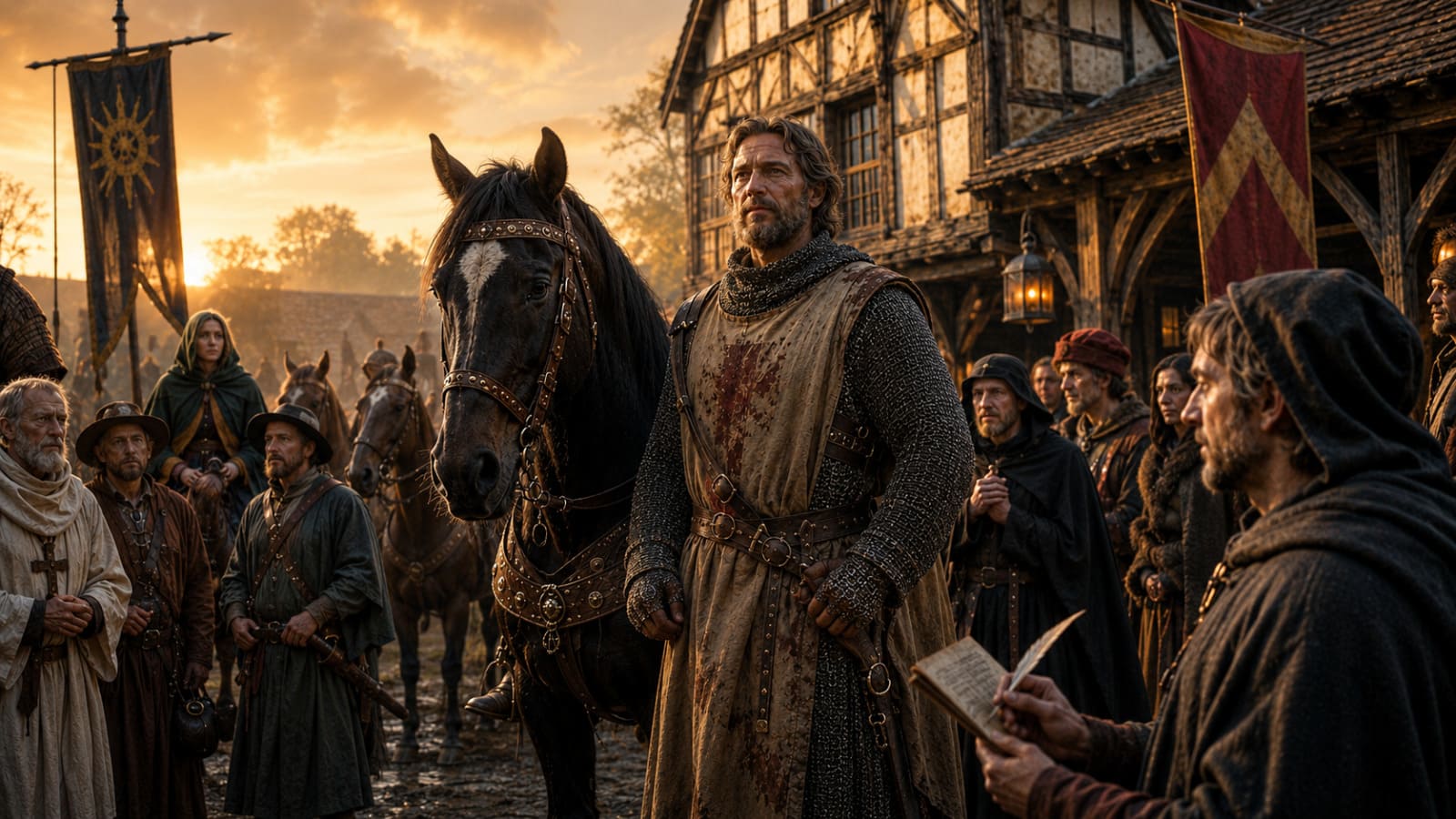
In lines 43–78 of The Canterbury Tales: The General Prologue, Geoffrey Chaucer introduces the first character of his celebrated portrait gallery: the Knight. Honoring his promise to begin according to social rank, Chaucer places this seasoned warrior at the very top of the pilgrim hierarchy. What follows is a masterpiece of medieval characterization that blends sweeping military grandeur with striking personal humility, introducing one of the most respected—and debated—figures in English literature.
Lines 43–78: The Portrait of the Knight
Middle English
A KNYGHT ther was, and that a worthy man,
That fro the tyme that he first bigan
To riden out, he loved chivalrie,
Trouthe and honour, fredom and curteisye.
Ful worthy was he in his lordes werre,
And therto hadde he riden, no man ferre,
As wel in cristendom as in hethenesse,
And evere honoured for his worthynesse.
At Alisaundre he was whan it was wonne.
Ful ofte tyme he hadde the bord bigonne
Aboven alle nacions in Pruce;
In Lettow hadde he reysed and in Ruce,
No cristen man so ofte of his degree.
In Gernade at the seege eek hadde he be
Of Algezir, and riden in Belmarye.
At Lyeys was he and at Satalye,
Whan they were wonne, and in the Grete See
At many a noble armee hadde he be.
At mortal batailles hadde he been fiftene,
And foughten for oure feith at Tramyssene
In lystes thries, and ay slayn his foe.
This ilke worthy knyght hadde been also
Somtyme with the lord of Palatye
Agayn another hethen in Turkye.
And everemoore he hadde a sovereyn prys;
And though that he were worthy, he was wys,
And of his port as meeke as is a mayde.
He nevere yet no vileynye ne sayde
In al his lyf unto no maner wight.
He was a verray, parfit gentil knyght.
But, for to tellen yow of his array,
His hors were goode, but he was nat gay.
Of fustian he wered a gypon
Al bismotered with his habergeon,
For he was late ycome from his viage,
And wente for to doon his pilgrymage.
— Geoffrey Chaucer, The Canterbury Tales: The General Prologue (Lines 43-78)
Modern English
There was a Knight, and he was a worthy man,
Who from the time that he first began
To ride out on campaigns, loved chivalry,
Truth and honor, generosity and courtesy.
He was very worthy in his lord's war,
And for that purpose he had ridden—no man farther—
Both in Christian lands and in heathen territories,
And was always honored for his worthiness.
He was at Alexandria when it was won.
Very often he had sat at the head of the table
Above knights of all nations in Prussia;
In Lithuania he had campaigned, and in Russia,
No Christian man of his rank had done so more often.
In Granada at the siege he had also been
Of Algeciras, and had ridden in Morocco.
He was at Ayas and at Attalia,
When they were won, and in the Mediterranean Sea
He had been part of many a noble armed expedition.
He had been in fifteen mortal battles,
And had fought for our faith at Tlemcen
Three times in formal duels, and always slain his foe.
This same worthy knight had also been
At one time with the lord of Palatia
Against another heathen ruler in Turkey.
And evermore he held an outstanding reputation;
And although he was brave and worthy, he was wise,
And in his bearing as meek as a maiden.
He never yet said any rude or villainous word
In all his life to any kind of person.
He was a true, perfect, noble knight.
But, to tell you about his clothing and equipment,
His horses were good, but he was not flamboyantly dressed.
He wore a tunic of coarse fustian cloth
All stained and rust-spotted by his chainmail coat,
For he had just recently returned from his expedition,
And went immediately to make his pilgrimage.
Summary
Among the pilgrims there was a Knight, a truly noble and honorable man who, from the very moment he first rode out on military campaigns, dedicated his life to chivalry, truth, honor, generosity, and courtesy. He had fought with immense distinction in his sovereign's wars, riding farther into both Christian and pagan lands than any other man, and earning universal respect for his valor. His military resume spanned the known world: he was present at the conquest of Alexandria in Egypt; he was given the seat of honor above knights of all nations in Prussia; and he campaigned extensively in Lithuania and Russia—more frequently than any other Christian knight of his rank. He fought in the siege of Algeciras in Granada, rode through Morocco, and took part in the conquests of Ayas and Attalia. Across the Mediterranean, he sailed with many noble armadas. In total, he survived fifteen deadly battles and fought three formal duels for the Christian faith in Algeria, slaying his opponent every time. He also served alongside the lord of Palatia in Turkey against pagan forces.
Yet, despite his fierce military prowess and supreme international reputation, he possessed profound wisdom and carried himself with the gentle meekness of a maiden. In his entire life, he never spoke a rude, boorish, or insulting word to anyone of any social class. He was, in every sense, a truly perfect and noble knight. As for his appearance and equipment, he rode excellent horses, but his attire was modest and practical. He wore a simple tunic of coarse fustian cloth that was permanently stained and discolored by the rust and oil of his heavy chainmail armor. He had only just returned from his latest overseas campaign and had set out immediately, without even stopping to change his clothes, to offer thanks on his pilgrimage.
Word Meanings
Worthy – Noble, honorable, brave, and distinguished of character
Chivalrie – The medieval knightly code encompassing military skill, ethics, and social etiquette
Trouthe – Truth, loyalty, integrity, and fidelity to one's word
Fredom – Generosity, magnanimity, and liberality of spirit
Curteisye – Courtesy, graciousness, and refined manners
Hethenesse – Heathen or non-Christian lands
Bord bigonne – Sat at the head of the table (a profound place of honor at military feasts)
Reysed – Campaigned or gone on a military expedition
Degree – Social rank or station
Grete See – The Mediterranean Sea
Mortal batailles – Fatal or deadly battles (where no quarter was asked or given)
Lystes – Enclosed fields or arenas for formal knightly duels and tournaments
Ilke – Same
Sovereyn prys – Supreme reputation, renown, or price/value
Wys – Wise, prudent, and emotionally disciplined
Port – Bearing, demeanor, or deportment
Vileynye – Rudeness, boorishness, slander, or conduct unbecoming a gentleman
Wight – Person, creature, or human being
Verray, parfit gentil – True, perfect, and noble (the ultimate chivalric ideal)
Array – Dress, attire, and military equipment
Fustian – A thick, durable, coarse cloth made of cotton and flax
Gypon – A tunic or padded doublet worn under or over armor
Bismotered – Stained, smudged, soiled, or rust-marked
Habergeon – A jacket or coat of chainmail armor
Viage – Voyage, expedition, or military campaign
Explanation
Chaucer’s portrait of the Knight serves as the moral anchor of The General Prologue. In the medieval worldview of the Three Estates—those who fight, those who pray, and those who work—the Knight represents the highest secular ideal: a protector of the realm who uses his martial strength exclusively in the service of God, justice, and his sovereign. Chaucer defines this nobility immediately through the core values of the chivalric code: "trouthe and honour, fredom and curteisye." Unlike many aristocratic figures of the late fourteenth century who had begun treating knighthood as a fashionable status symbol, this Knight embodies genuine ethical substance over superficial display.
The central portion of the portrait is dedicated to an exhaustive, almost overwhelming catalog of the Knight’s military campaigns. Spanning over forty years of warfare (roughly from the 1340s to the 1380s), his service records take him to the far edges of the medieval world: Prussia, Lithuania, Russia, Spain, North Africa, and the Eastern Mediterranean. Rather than participating in the politically messy domestic conflicts of the Hundred Years' War against France, the Knight has spent his life engaged in crusades along the religious frontiers of Christendom. By placing him at historical battles like the fall of Alexandria (1365) and the siege of Algeciras (1344), Chaucer paints him as an international veteran of legendary proportions—a man universally recognized and honored, sitting at the "bord bigonne" above knights of all nations.
Yet, the true genius of the portrait lies in the dramatic contrast between his lethal battlefield prowess and his private demeanor. Though he is a killer of fifteen men in "mortal batailles," he is never arrogant or boastful. Instead, he is "wys" (prudent) and carries himself as "meeke as is a mayde." Furthermore, Chaucer grounds this spiritual purity in the Knight’s physical clothing ("array"). While he spares no expense on his horses—essential tools of his trade—his personal attire is strikingly humble. He wears a coarse, utilitarian "fustian" tunic that bears the dirty, rust-stained imprints ("bismotered") of his heavy chainmail armor. This crucial physical detail reveals his sincere piety: having just returned from a brutal military campaign, he has bypassed the comforts of home and clean garments to ride immediately to Canterbury, eager to thank God for preserving his life.
Literary Devices
Asyndeton & Accumulation: Chaucer stacks place names and battles in rapid, uninterrupted succession (Alexandria, Prussia, Lithuania, Russia, Granada, Morocco), creating a cumulative rhetorical effect that emphasizes the Knight's tireless, lifelong dedication to warfare.
Simile: Comparing the hardened warrior's demeanor to a young maiden ("as meeke as is a mayde") creates a powerful juxtaposition between martial lethality and Christian humility.
Hyperbole / Idealization: Phrases like "no man ferre" (no man rode farther) and "nevere yet no vileynye ne sayde / In al his lyf" elevate the Knight from a mere realistic individual into a romantic, allegorical perfection of chivalry.
Symbolism (The Bismotered Gypon): The rust-stained tunic symbolizes the Knight's rejection of vanity and worldly pride, contrasting his inner spiritual cleanliness with his outward physical grime.
Juxtaposition: The Knight's worn, stained working clothes stand in immediate, deliberate contrast to the flamboyant, fashion-conscious attire of his son, the Squire, who will be introduced next.
Significance
The Knight's portrait establishes the highest standard of secular morality against which all other pilgrims in The Canterbury Tales will inevitably be measured. By describing him as a "verray, parfit gentil knyght," Chaucer gives the audience a benchmark of integrity, duty, and spiritual devotion. In a fourteenth-century society increasingly shaken by social unrest, aristocratic corruption, and the commercialization of values, the Knight represents a nostalgic, perhaps fading ideal of the Old World: an aristocrat whose power is restrained by deep humility and unquestioning faith. His quiet, unpretentious arrival at the Tabard Inn sets a solemn and dignified tone before the social fabric of the pilgrimage unravels into the earthly humor and rivalry of the tales to come.