
The Canterbury Tales: The General Prologue (Lines 35-42)
In lines 35–42 of The Canterbury Tales The General Prologue, Chaucer pauses the plot to lay out his literary manifesto. He plans to describe each pilgrim by their social rank (degree), clothing (array), and morals (condicioun). This subjective approach introduces his famous narrative irony.


In lines 35–42 of The Canterbury Tales: The General Prologue, Geoffrey Chaucer pauses the forward momentum of his narrative to establish his literary manifesto and observational methodology. Having introduced the setting and assembled the diverse fellowship of twenty-nine travelers at the Tabard Inn, the narrator steps directly into the foreground to explain how he intends to present his fellow pilgrims before the journey to Canterbury officially begins.
Lines 35–42: The Narrator's Plan and Method of Presentation.
Middle English
But nathelees, whil I have tyme and space,
Er that I ferther in this tale pace,
Me thynketh it acordaunt to resoun
To telle yow al the condicioun
Of ech of hem, so as it semed me,
And whiche they weren, and of what degree,
And eek in what array that they were inne;
And at a knyght thanne wol I first bigynne.
— Geoffrey Chaucer, The Canterbury Tales: The General Prologue (Lines 35-42)
Modern English
But nevertheless, while I have time and space,
Before I proceed any further in this tale,
It seems to me reasonable and appropriate
To tell you the complete condition
Of each of them, according to how it appeared to me,
And who they were, and of what social rank,
And also what manner of dress they were wearing;
And with a knight, then, I will first begin.
Summary
But nevertheless, while I still have time and opportunity before I move any further forward with this story, it seems only logical and proper to tell you about the general condition and circumstances of every single traveler, exactly as they appeared to me. I want to describe who they were, what social rank they held in society, and also what kind of clothing and equipment they were wearing. And to keep proper order, I will begin my portraits with a knight.
Word Meanings
Nathelees – Nevertheless or none the less
Tyme and space – Time and opportunity (or artistic scope)
Er that – Before
Pace – Step, proceed, pass, or go forward
Me thynketh – It seems to me (impersonal verb form)
Acordaunt to resoun – According to reason; sensible, logical, or fitting
Condicioun – Condition, circumstances, social standing, or general nature
Ech of hem – Each of them
So as it semed me – As it appeared to me (emphasizing subjective observation)
Whiche – What sort of people; who
Degree – Social rank, status, or station in the medieval hierarchy
Eek – Also or moreover
Array – Dress, clothing, attire, or equipment
Thanne – Then
Wol I – I will or I wish to
Bigynne – Begin
Explanation
In this brief but critical passage, Chaucer halts the plot—the pilgrims have just agreed to wake up early and ride together—to address the reader directly. He recognizes that before narrating a journey involving twenty-nine distinct voices, the audience must first understand who these people are. By declaring his intention to sketch each traveler while he has "tyme and space," Chaucer establishes the architectural blueprint for the rest of the General Prologue: a sweeping, systematic portrait gallery of fourteenth-century English society.
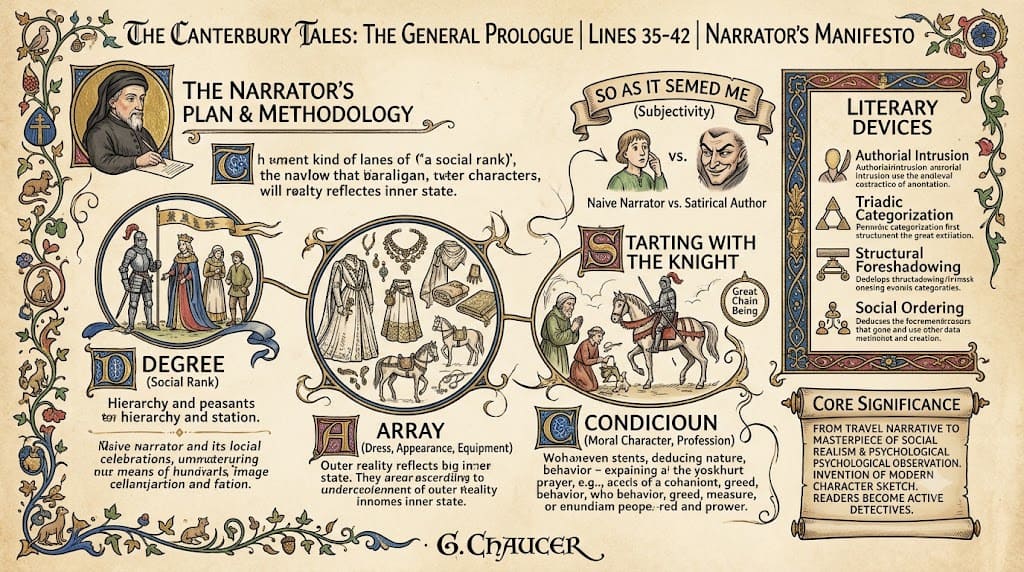
Chaucer outlines three specific criteria he will use to analyze each pilgrim: their "degree" (social rank or class), their "array" (clothing, horses, and outward appearance), and their "condicioun" (their moral character, profession, and personal behavior). In medieval literature, outer appearance was widely believed to reflect inner reality. By paying close attention to fabrics, colors, jewelry, and grooming, Chaucer uses physical details as psychological clues—allowing readers to deduce whether a pilgrim is genuinely devout or secretly worldly and corrupt.
Perhaps the most important phrase in this section is "so as it semed me" ("as it appeared to me"). By framing these portraits as his own personal impressions rather than objective, divine truths, Chaucer introduces his most brilliant literary tool: subjective narrative irony. "Chaucer the Pilgrim" presents himself as an observant, somewhat naive observer who often takes his companions' boastful claims at face value. This gives "Chaucer the Author" plausible deniability to gently satirize corrupt clergy and greedy professionals without ever sounding like a bitter moralist. Finally, his decision to begin with the Knight ("at a knyght thanne wol I first bigynne") respects the traditional medieval Great Chain of Being and the Three Estates, starting at the very top of the secular social hierarchy before moving down to merchants, craftsmen, and peasants.
Literary Devices
Authorial Intrusion / Metafiction: The narrator steps out of the story's timeline to speak directly to the audience about the construction and pacing of his own poem.
Subjectivity ("So as it semed me"): A foundational narrative device that filters all upcoming descriptions through the narrator's personal lens, creating space for irony, humor, and satire.
Triadic Categorization: Chaucer explicitly divides his character analysis into three distinct lenses: character/identity ("whiche they weren"), social rank ("what degree"), and costume/equipment ("what array").
Structural Foreshadowing: These lines act as a formal table of contents for lines 43 through 714, setting up expectations for a systematic, orderly presentation of the pilgrims.
Social Ordering: The conscious choice to start with the Knight reinforces medieval social norms, establishing a formal hierarchy that will later be humorously shattered when lower-class pilgrims like the Miller drunkenly interrupt the storytelling order.
Significance
These eight lines are a hinge point in the Prologue: they close the introductory scene-setting and formally open the sequence of pilgrim portraits that make up the bulk of the General Prologue. By explicitly stating his method — describing identity, rank, and dress — Chaucer signals that the coming portraits will function as a broad social survey of fourteenth-century England, using outward appearance and status as a lens for revealing (and often ironically undercutting) each pilgrim's inner character. The choice to begin with the knight also establishes the social hierarchy that structures the whole gallery, even as Chaucer will go on to play with and challenge that same hierarchy through his tone and detail.