
The Canterbury Tales: The General Prologue (Lines 19-34)
From spring showers to the cozy Tabard Inn: explore lines 19–34 of Chaucer's General Prologue. Dive into side-by-side translations, key Middle English vocabulary, and a deep-dive analysis of how Chaucer sets the framework for The Canterbury Tales.

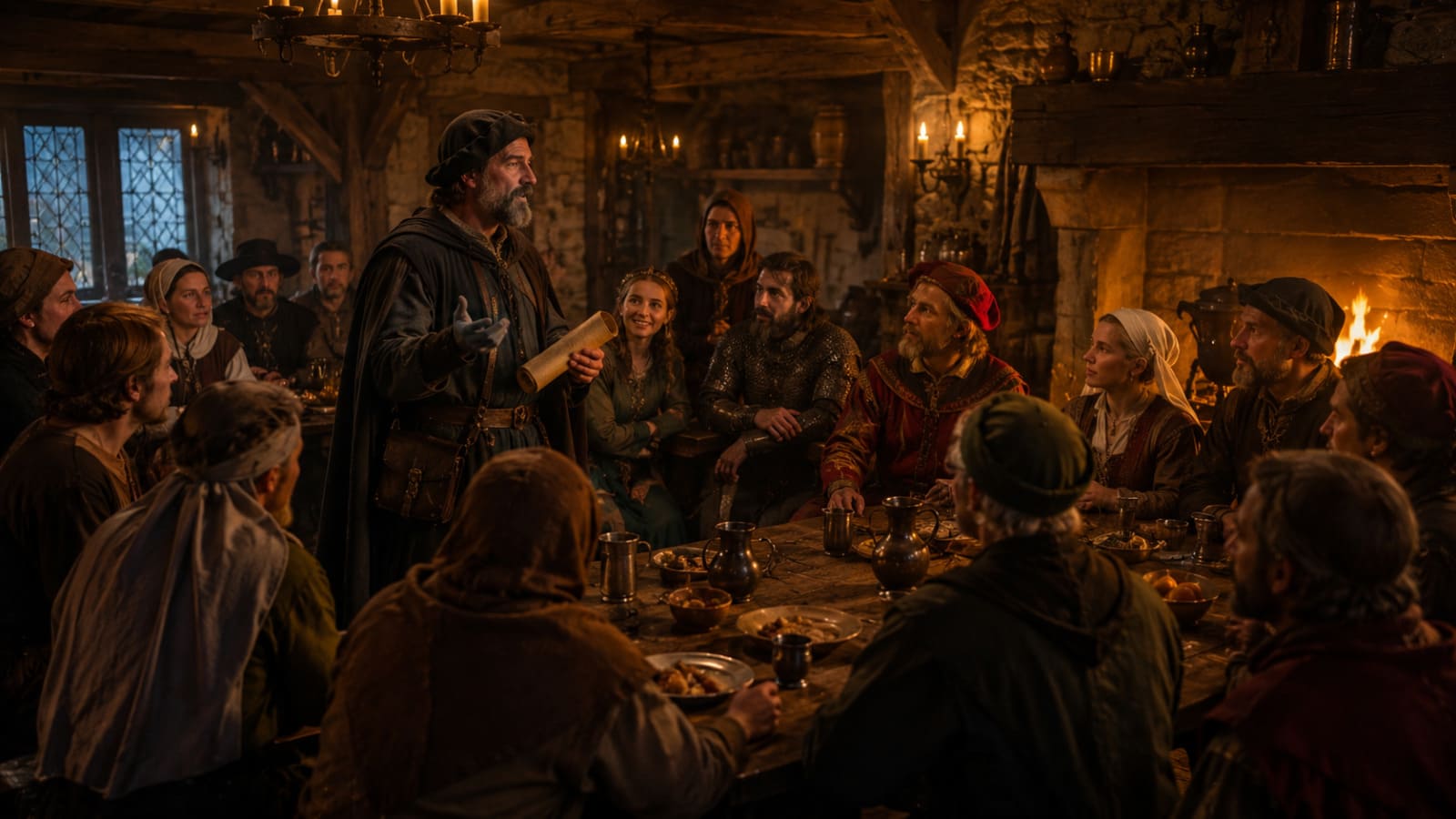
In lines 19-34 of The Canterbury Tales: The General Prologue, Chaucer shifts from explaining why pilgrims travel to introducing the setting where his story begins. At the Tabard Inn in Southwark, he encounters a diverse company of travelers bound for Canterbury. These lines establish the framework of the entire work and introduce the pilgrims whose stories will follow throughout the collection.
Lines 19-34: The Meeting at the Tabard Inn.
Middle English
Bifel that in that seson on a day,
In Southwerk at the Tabard as I lay
Redy to wenden on my pilgrymage
To Caunterbury with ful devout corage,
At nyght was come into that hostelrye
Wel nyne and twenty in a compaignye
Of sondry folk, by aventure yfalle
In felaweshipe, and pilgrimes were they alle,
That toward Caunterbury wolden ryde.
The chambres and the stables weren wyde,
And wel we weren esed atte beste.
And shortly, whan the sonne was to reste,
So hadde I spoken with hem everichon
That I was of hir felaweshipe anon,
And made forward erly for to ryse,
To take oure wey ther as I yow devyse.
— Geoffrey Chaucer, The Canterbury Tales: The General Prologue (Lines 19-34)
Modern English
It happened that during that season, on a certain day,
I was staying at the Tabard Inn in Southwark,
Ready to set out on my pilgrimage
To Canterbury with a truly devout heart.
That night there arrived at the inn
About twenty-nine people in a company,
People of various kinds who had happened by chance
To come together in fellowship, and all were pilgrims,
Who intended to ride toward Canterbury.
The rooms and stables were spacious,
And we were accommodated in the best manner.
In short, when the sun had set,
I had spoken with every one of them
And soon became a member of their company,
And we agreed to rise early
To begin our journey, as I shall now describe.
Summary
During that season of renewal, on a particular day while I was staying at the Tabard Inn in Southwark, fully prepared and eager in my heart to set out on a pilgrimage to Canterbury, a diverse company of twenty-nine travelers arrived at the inn just as evening fell. They were people from all walks of life who had come together by chance, united by their shared intention to ride to Canterbury. The inn was large and accommodating, with spacious rooms for the guests and wide stalls for the horses, and we were looked after with the finest hospitality. Before the sun had completely set, I had spoken with every single one of them and was warmly accepted into their group. Together, we agreed to wake up early the following morning to begin our journey to the shrine I am about to describe to you.
Word Meanings
Bifel – It happened or occurred by chance
Seson – Season (referring to springtime in April)
Southwerk – Southwark, a bustling district on the south bank of the River Thames, opposite London
Tabard – The Tabard Inn, a famous medieval lodging house named after a sleeveless jacket worn by heralds
Lay – Lodged, stayed, or rested
Wenden – To travel, depart, or go
Devout corage – Pious heart, sincere spirit, or earnest devotion
Hostelrye – An inn or lodging house for travelers
Wel nyne and twenty – Exactly twenty-nine people
Sondry folk – Diverse, various, or assorted people
Aventure yfalle – Fallen by chance, coincidence, or good fortune
Felaweshipe – Companionship, group, or brotherhood
Wolden ryde – Intended or wished to ride
Wyde – Wide, spacious, or roomy
Esed atte beste – Accommodated, entertained, and made comfortable in the best possible manner
Everichon – Every single one
Anon – Immediately, straightaway, or soon
Made forward – Made an agreement, covenant, or arrangement
Devyse – Describe, recount, or explain
Explanation
In this section, Chaucer skillfully shifts his poetic lens from the grand, universal forces of nature described in the opening lines down to a specific, realistic setting: the Tabard Inn in Southwark. Located just across London Bridge, Southwark was the natural starting point for travelers heading southeast toward Kent and the coast. By anchoring the narrative in a real, recognizable medieval tavern, Chaucer grounds his spiritual journey in the everyday world of commerce, hospitality, and social interaction.
Here, we also meet Chaucer's literary persona—often called "Chaucer the Pilgrim." Unlike the omniscient, detached narrator of a traditional epic, this narrator is a participant who mixes freely with the guests, observing their behavior with curiosity and warmth. When twenty-nine travelers arrive at nightfall, they do not represent a single social class; they are "sondry folk"—a rich tapestry of fourteenth-century English society ranging from knights and clergy to merchants and craftsmen. Their gathering "by aventure" (by chance) highlights the unique democratic nature of a medieval pilgrimage, one of the few occasions where individuals of vastly different ranks and occupations would travel, eat, and sleep side by side.
Chaucer also emphasizes the warmth and comfort of the inn. The spacious rooms and stables, along with the excellent hospitality ("esed atte beste"), create an atmosphere of conviviality that loosens tongues and encourages storytelling. By chatting with every single traveler before sunset, the sociable narrator integrates himself into their fellowship. This simple social transaction is essential to the structure of *The Canterbury Tales: it justifies how the narrator knows intimate details about each pilgrim's life, appearance, and character, setting the foundation for the famous character portraits that follow.
Literary Devices
First-Person Narration: Chaucer introduces himself ("as I lay") as both a character inside the story and the observer recounting it, blurring the line between author and narrator.
Realistic Setting: Placing the story at the Tabard Inn in Southwark anchors the fiction in documented, everyday fourteenth-century geography.
Microcosm / Symbolism: The twenty-nine pilgrims function as a microcosm of English society, representing the Three Estates (those who fight, those who pray, and those who work) coming together under one roof.
Character Foreshadowing: The introduction of a diverse group of pilgrims prepares the reader for the many stories and personalities that follow.
Significance
These lines serve as the vital structural pivot of The Canterbury Tales. If lines 1–18 explain why people go on pilgrimages (a blend of natural impulse and spiritual devotion), lines 19–34 explain how this specific, legendary storytelling contest begins. By assembling a diverse group of strangers in a tavern and uniting them into a fellowship, Chaucer creates a literary framework capable of holding a wide variety of human voices, genres, and moral perspectives. The transition from solitude to community at the Tabard Inn marks the true birth of Chaucer's grand narrative experiment.