
Sonnet 5 by William Shakespeare: Analysis, Summary, and Meaning
Explore Sonnet 5 by William Shakespeare with our complete analysis, summary, and meaning. Discover themes of time, beauty, and preservation in this Renaissance masterpiece.


Introduction
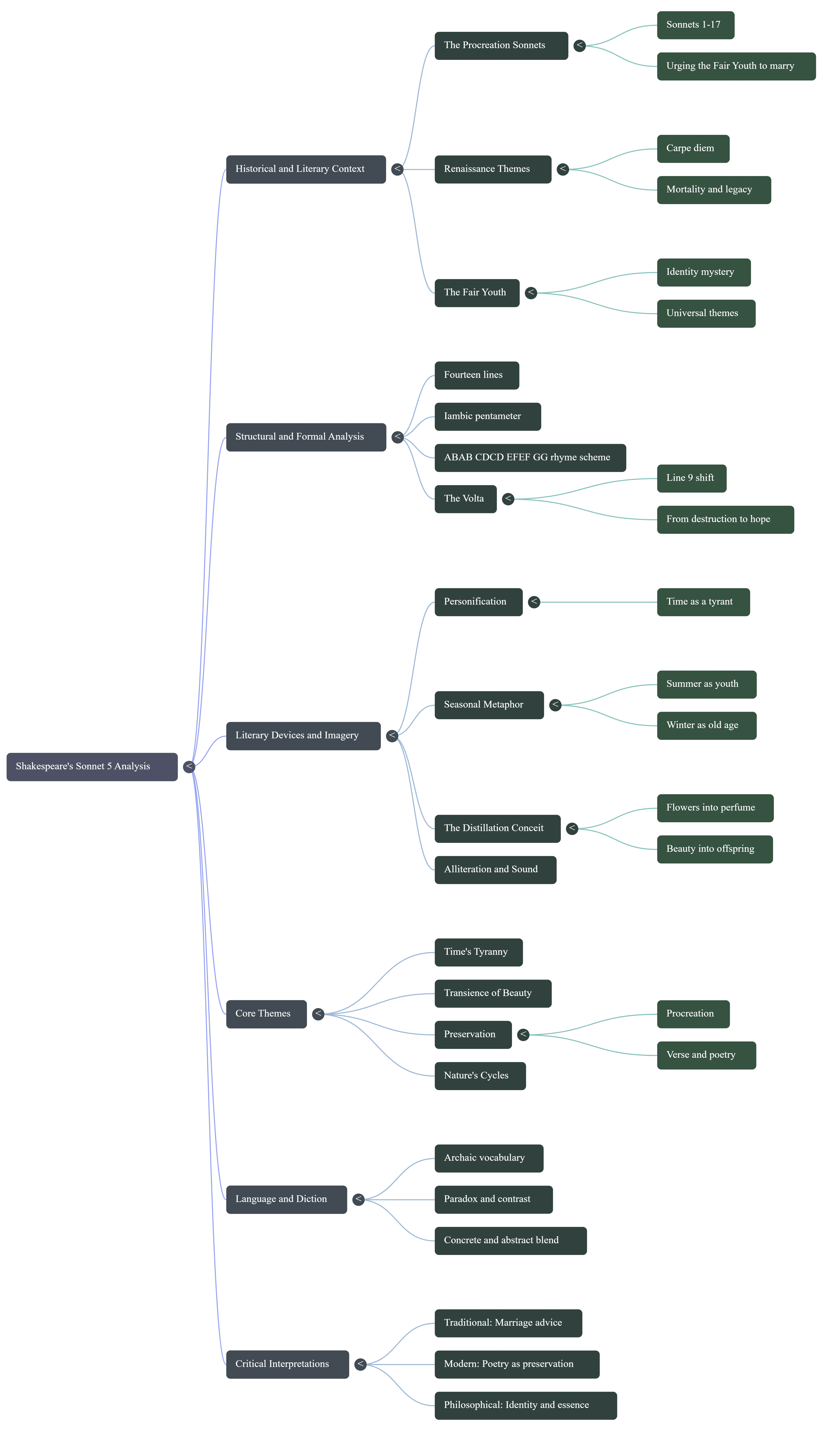
William Shakespeare's Sonnet 5 stands as a profound meditation on the relentless passage of time and the ephemeral nature of beauty. Written during the Renaissance period, this fourteen-line masterpiece forms part of the 'Fair Youth' sequence, wherein Shakespeare addresses a young man of exceptional beauty. The Sonnet 5 by William Shakespeare analysis reveals the poet's preoccupation with mortality and his ingenious solution to temporal decay: the preservation of beauty through procreation and verse. Through vivid seasonal imagery and metaphorical language, Shakespeare transforms a simple observation about nature's cycles into a compelling argument for immortality. This exploration examines the poem's structure, literary devices, themes, and enduring significance within the Shakespearean canon, offering readers a comprehensive understanding of one of literature's most elegant contemplations on time's destructive power.
Historical and Literary Context
Shakespeare's Sonnet Sequence
Shakespeare's 154 sonnets, published in 1609, represent one of English literature's greatest poetic achievements. Sonnet 5 occupies a crucial position within the opening seventeen sonnets, collectively known as the 'procreation sonnets'. These poems urge a beautiful young man to marry and produce heirs, thereby preserving his remarkable beauty for future generations. The Sonnet 5 by William Shakespeare analysis demonstrates how this particular poem functions as a bridge between the preceding sonnet's winter imagery and the subsequent sonnet's perfume metaphor, creating a cohesive narrative about time's passage.
Renaissance Attitudes Towards Beauty and Time
During the Elizabethan era, concepts of beauty, mortality, and legacy held profound cultural significance. The Renaissance obsession with carpe diem (seize the day) permeates Shakespeare's work, reflecting society's awareness of life's brevity. Poets frequently employed seasonal metaphors to explore human mortality, a convention Shakespeare masterfully deploys in Sonnet 5.
The Fair Youth Mystery
Scholars continue debating the Fair Youth's identity, with candidates ranging from Henry Wriothesley, Earl of Southampton, to William Herbert, Earl of Pembroke. Regardless of the addressee's true identity, the sonnets addressed to this figure explore universal themes that transcend their immediate occasion.
Complete Text and Summary
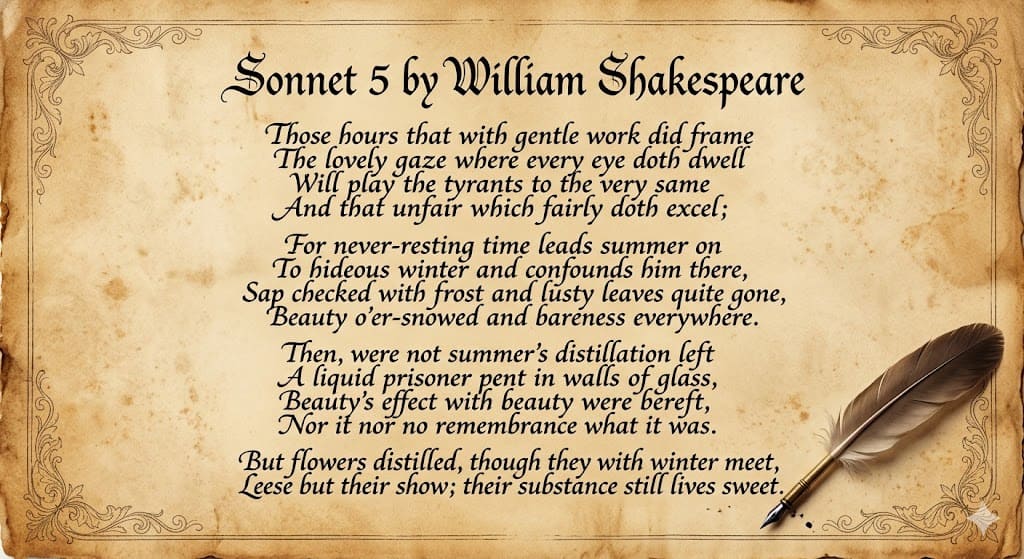
The Full Sonnet 5 by William Shakespeare
Those hours that with gentle work did frame
The lovely gaze where every eye doth dwell
Will play the tyrants to the very same
And that unfair which fairly doth excel;
For never-resting time leads summer on
To hideous winter and confounds him there,
Sap checked with frost and lusty leaves quite gone,
Beauty o’er-snowed and bareness everywhere.
Then, were not summer’s distillation left
A liquid prisoner pent in walls of glass,
Beauty’s effect with beauty were bereft,
Nor it nor no remembrance what it was.
But flowers distilled, though they with winter meet,
Leese but their show; their substance still lives sweet.
Sonnet 5 by William Shakespeare analysis Mind Map
Summary
Shakespeare opens by acknowledging that time, which initially created the young man's beauty, will inevitably destroy it. He employs the metaphor of summer transitioning to winter, illustrating how vibrant life succumbs to cold destruction. However, the poet offers hope through the image of distilled perfume—just as summer's essence can be preserved in liquid form, the youth's beauty can survive through offspring. The Sonnet 5 by William Shakespeare analysis reveals this central message: whilst physical appearance fades, essence endures through procreation.
Structural and Formal Analysis
Shakespearean Sonnet Form
Sonnet 5 adheres to the traditional Shakespearean (or English) sonnet structure, comprising fourteen lines of iambic pentameter arranged in three quatrains and a concluding couplet. The rhyme scheme follows the ABAB CDCD EFEF GG pattern, creating musicality whilst allowing thematic development across distinct sections.
Iambic Pentameter and Rhythm
Each line contains ten syllables arranged in five iambic feet (unstressed-stressed pattern). Consider the opening line: "Those HOURS, that WITH gentle WORK did FRAME." This rhythmic consistency creates a measured, contemplative tone appropriate for the poem's philosophical subject matter.
Volta and Thematic Shift
The volta, or thematic turn, occurs at line 9 ("Then, were not summer's distillation left"), where Shakespeare shifts from describing time's destruction to proposing a solution. This structural pivot mirrors the poem's movement from despair to hope, from problem to resolution.
Literary Devices and Imagery
Personification
Shakespeare personifies time and the hours as active agents. Time "plays the tyrant" and "leads summer on," transforming an abstract concept into a malevolent character who deliberately destroys beauty. This personification intensifies the threat facing the Fair Youth.
Seasonal Metaphor
The extended metaphor comparing human life to seasonal change forms the poem's backbone. Summer represents youthful beauty and vitality, whilst "hideous winter" symbolises old age and death. The phrase "Bare ruin'd choirs, where late the sweet birds sang" evokes both leafless tree branches and abandoned church choirs, suggesting both natural and spiritual desolation.
The Distillation Conceit
The central conceit of distilled perfume provides the Sonnet 5 by William Shakespeare analysis with its most ingenious imagery. Just as perfumers extract and preserve flowers' essence in "walls of glass," procreation preserves beauty's essence in offspring. This metaphor elegantly unites the natural world with human reproduction.
Alliteration and Sound
Shakespeare employs alliteration strategically: "gentle... gaze," "fairly... frame," and "flowers... distill'd" create musicality whilst emphasising key concepts. The harsh consonants in "hideous winter" contrast sharply with summer's softer sounds, reinforcing the thematic opposition.
Thematic Exploration
Time's Tyranny
The sonnet's primary theme concerns time's inevitable destruction of physical beauty. Shakespeare presents time paradoxically—the same force that creates beauty ultimately destroys it. The hours that "with gentle work did frame / The lovely gaze" will "play the tyrants to the very same," emphasising life's cruel irony.
Beauty's Transience
Physical attractiveness proves temporary and vulnerable. The Sonnet 5 by William Shakespeare analysis demonstrates how Shakespeare accepts beauty's ephemeral nature whilst refusing to accept its total annihilation. The young man's current perfection will fade like summer yields to winter, yet essence need not perish entirely.
Preservation Through Procreation
Shakespeare proposes procreation as beauty's salvation. Just as distilled perfume captures flowers' essence beyond their blooming season, children preserve parents' beauty beyond their prime. The concluding couplet affirms that distilled flowers "Leese but their show; their substance still lives sweet"—they lose only appearance whilst retaining essence, paralleling how offspring carry forward parental qualities.
Nature's Cycles
The poem acknowledges natural cycles whilst suggesting humans can transcend them through conscious action. Unlike passive flowers subject to seasonal change, humans possess agency to ensure their qualities endure.
Critical Interpretations
Traditional Reading
Traditional scholarship interprets Sonnet 5 straightforwardly as encouraging the Fair Youth to marry and produce heirs. This reading situates the poem within Elizabethan aristocratic concerns about lineage and succession.
Modern Perspectives
Contemporary critics examine the Sonnet 5 by William Shakespeare analysis through various lenses. Some scholars argue Shakespeare implies poetry itself serves as the preservative "distillation," suggesting the sonnets immortalise the youth more effectively than biological offspring. Others explore homoerotic subtexts within the Fair Youth sonnets, questioning the procreation argument's sincerity.
Philosophical Dimensions
Beyond immediate concerns about marriage, the sonnet engages profound philosophical questions about identity, essence, and mortality. What constitutes the "self" that survives physical decay? Can essence truly separate from appearance? These questions resonate across centuries.
Language and Diction
Archaic Vocabulary
Shakespeare employs Elizabethan language requiring modern readers' attention. "Unfair" means "make ugly," whilst "confounds" suggests "destroys" or "ruins." Understanding these terms proves essential for accurate interpretation.
Paradox and Contrast
The poem thrives on contrasts: gentle versus tyrannical, summer versus winter, creation versus destruction, show versus substance. These oppositions structure the argument and heighten emotional impact.
Concrete and Abstract
Shakespeare masterfully blends concrete imagery (frost, leaves, glass) with abstract concepts (time, beauty, essence), making philosophical ideas tangible and emotionally resonant.
Connection to Adjacent Sonnets
Sonnet 4's Foundation
Sonnet 4 concludes by asking, "Having no fair to bequeath when death approaches?" This question sets up Sonnet 5's answer: preserve beauty through distillation (procreation).
Sonnet 6's Continuation
Sonnet 6 explicitly develops the distillation metaphor, urging: "Then let not winter's ragged hand deface / In thee thy summer, ere thou be distill'd." The Sonnet 5 by William Shakespeare analysis reveals how these three sonnets form a tightly integrated argument.
Thematic Unity
Sonnets 1-17 collectively develop the procreation theme with increasing sophistication. Sonnet 5's position midway through this sequence allows Shakespeare to employ more complex imagery, building upon earlier, simpler arguments.
Enduring Relevance and Legacy
Universal Themes
Despite its Renaissance origins, Sonnet 5 addresses timeless human concerns. Every generation confronts mortality and seeks meaning beyond physical existence. Shakespeare's elegant articulation of these anxieties explains the poem's continued resonance.
Influence on Later Poetry
The sonnet's imagery and themes influenced countless later poets. The Romantics particularly admired Shakespeare's natural imagery, whilst Victorian poets engaged with his meditation on beauty's transience.
Contemporary Applications
Modern readers continue finding relevance in the Sonnet 5 by William Shakespeare analysis. In an age obsessed with youth and appearance, Shakespeare's acknowledgement of beauty's temporality whilst affirming essence's permanence offers philosophical comfort and practical wisdom.
Conclusion
Sonnet 5 by William Shakespeare exemplifies the poet's genius for transforming personal address into universal meditation. Through masterful employment of seasonal metaphor, personification, and the central distillation conceit, Shakespeare confronts humanity's most profound anxiety—temporal existence and inevitable decay—whilst proposing an elegant solution. The poem's formal perfection, with its balanced quatrains building towards the resolving couplet, mirrors its thematic movement from problem to resolution. Whether read as practical advice to a young aristocrat, philosophical exploration of identity and essence, or meta-poetic claim about verse's immortalising power, this sonnet rewards careful attention with layers of meaning. Its acknowledgement that beauty "leese but their show" whilst "substance still lives sweet" offers enduring consolation: though appearance fades, what truly matters—essence, character, legacy—can transcend time's tyranny through conscious preservation.