
Sonnet 4 by William Shakespeare: Analysis, Summary, and Meaning


In the vast sequence of the "Fair Youth" sonnets, Sonnet 4 by William Shakespeare stands out as a sophisticated lecture on economics. But the Bard isn't talking about money; he is talking about genetics, beauty, and the crushing inevitability of time.
While previous poems plead with the youth to reproduce, Sonnet 4 by William Shakespeare shifts the argument to a legalistic, financial framework. Here, the poet argues that beauty is not a gift given freely by Nature, but a loan. And like any strict creditor, Nature expects a return on her investment.
If you are struggling to understand the complex financial metaphors or the phrase "Unthrifty loveliness," this guide breaks down Sonnet 4 by William Shakespeare line by line.
The Text of Sonnet 4 by William Shakespeare
Before analyzing the themes, it is essential to read the poem in its entirety to catch the rhythm and the shifting argument.
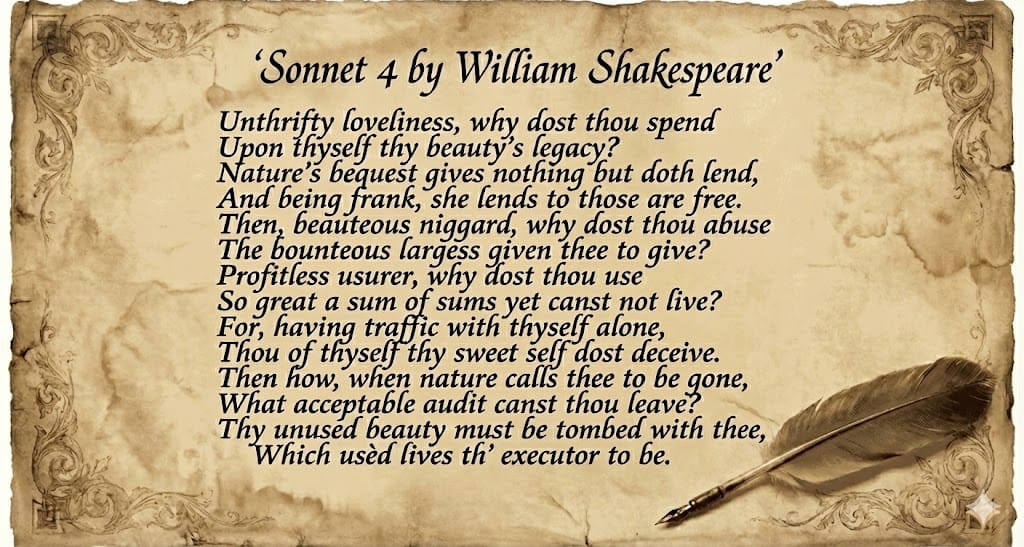
Unthrifty loveliness, why dost thou spend
Upon thyself thy beauty’s legacy?
Nature’s bequest gives nothing but doth lend,
And being frank, she lends to those are free.
Then, beauteous niggard, why dost thou abuse
The bounteous largess given thee to give?
Profitless usurer, why dost thou use
So great a sum of sums yet canst not live?
For, having traffic with thyself alone,
Thou of thyself thy sweet self dost deceive.
Then how, when nature calls thee to be gone,
What acceptable audit canst thou leave?
Thy unused beauty must be tombed with thee,
Which usèd lives th’ executor to be.
Line-by-Line Analysis of Sonnet 4 by William Shakespeare
The text packs this sonnet with the language of banking and law. To understand Sonnet 4 by William Shakespeare, we have to treat the Fair Youth not just as a beautiful man, but as a bad businessman who is mishandling his assets.
Quatrain 1 (Lines 1-4): The Economic Metaphor
"Unthrifty loveliness, why dost thou spend / Upon thyself thy beauty’s legacy?"
The opening hook is a paradox. In Sonnet 4 by William Shakespeare, the youth is called "unthrifty" (wasteful) precisely because he is keeping everything to himself. In the poet's eyes, hoarding beauty is a form of spending it. If you don't share it (by having a child), you are consuming it until it is gone.
"Nature’s bequest gives nothing but doth lend..."
This is the central thesis of Sonnet 4 by William Shakespeare. We often think of our physical attributes as our own property. Shakespeare corrects this: Nature is a generous ("frank") lender, but she is still a lender. She has loaned the youth his beauty, and she expects him to pass it on to a new generation.
Quatrain 2 (Lines 5-8): The Abuse of the Gift
"Then, beauteous niggard, why dost thou abuse / The bounteous largess given thee to give?"
Here, the language becomes sharper. A "niggard" is a miser or a hoarder. The poet asks why the youth is abusing the "largess" (generosity) of nature. The purpose of the gift was to give it away, yet the youth clutches it tight.
"Profitless usurer, why dost thou use / So great a sum of sums, yet canst not live?"
This contains a brilliant oxymoron central to Sonnet 4 by William Shakespeare: Profitless usurer.
- A usurer is someone who lends money at high interest to make a profit.
- The youth is a "usurer" because he is obsessed with his own "gold" (beauty).
- However, he is "profitless" because he isn't creating "interest" (a child). He has all the capital but is generating zero returns.
Quatrain 3 (Lines 9-12): The Inevitability of Death
"For having traffic with thyself alone..."
This line is often read with a double meaning. On the surface, it means dealing only with oneself—social isolation. On a slightly more risqué level, "traffic with thyself" hints at autoeroticism or narcissism. By refusing to "traffic" (trade/interact) with a woman, the youth is deceiving himself.
"Then how, when nature calls thee to be gone, / What acceptable audit canst thou leave?"
The metaphor reaches its climax here. Death is presented as an audit. When Nature comes to check the books at the end of the youth's life, she will want to see where her loan went. If the youth dies childless, his accounts won't balance. He will be bankrupt in the eyes of eternity.
The Couplet (Lines 13-14): The Final Warning
"Thy unused beauty must be tomb’d with thee, / Which, used, lives th’ executor to be."
The conclusion is stark. If the youth keeps his beauty "unused" (childless), it rots in the grave with him. But if he "uses" it, his child becomes his "executor"—the person who manages his estate and carries on his legacy. The child is the receipt that proves the loan was paid back.
Key Themes in Sonnet 4 by William Shakespeare
1. Nature as a Creditor
In the Romantic era, poets often viewed Nature as a mother or a healer. However, Sonnet 4 by William Shakespeare takes a more pragmatic, almost capitalist view. Nature is a business partner. She provides the raw materials (genes/beauty), but she demands production. This theme strips the romance away from beauty and turns it into a responsibility.
2. Narcissism vs. Legacy
The psychological argument in Sonnet 4 by William Shakespeare is directed against self-love. The Fair Youth is so enamored with his own reflection that he fails to see the bigger picture. Shakespeare argues that true self-love actually requires looking outside oneself. By loving a partner and creating a child, you preserve the "self" you love so much.
3. Usury and Economic Imagery
Why use words like bequest, legacy, audit, usurer, and traffic?
- To create urgency: Financial debts have due dates. By framing beauty as a debt, Sonnet 4 by William Shakespeare imposes a deadline on the youth.
- To highlight value: Money was the universal language of value in Elizabethan England. By equating beauty with a "sum of sums," the poet emphasizes just how precious the youth is.
Literary Devices and Form
- Oxymoron: The phrase "Unthrifty loveliness" and "Profitless usurer" combine contradictory terms to show the youth's confused state of being.
- Personification: Nature is personified as a distinct character—a frank, generous, but demanding woman who interacts with the youth.
- Polyptoton: Shakespeare plays with word forms, such as "use" (verb) and "usurer" (noun), or "give" and "given." This repetition mimics the cycle of lending and repaying that Sonnet 4 by William Shakespeare advocates.
- Structure: This is a classic Shakespearean Sonnet: Three quatrains (4 lines each) followed by a rhyming couplet, written in iambic pentameter (da-DUM da-DUM da-DUM da-DUM da-DUM).
People Also Ask (FAQ)
What is the meaning of "Unthrifty Loveliness"?
"Unthrifty loveliness" is a paradox used in Sonnet 4 by William Shakespeare to describe the Fair Youth. It means that while the young man is beautiful (lovely), he is being wasteful (unthrifty) with that beauty by not having children to preserve it.
Why does Shakespeare call the youth a "profitless usurer"?
He calls the youth a "profitless usurer" because the youth acts like a greedy money-lender (usurer) with his beauty, keeping it all to himself. However, he is "profitless" because he fails to generate any "interest"—which, in this metaphor, would be a child.
What is the central message of Sonnet 4 by William Shakespeare?
The central message is that beauty is a loan from Nature, not a free gift. Therefore, human beings have a duty to reproduce in order to pay back that loan and ensure their beauty survives after death.
Conclusion
Sonnet 4 by William Shakespeare is a masterclass in persuasion. The poet realizes that begging the youth to marry for "love" isn't working, so he pivots to logic. He speaks to the youth's vanity and self-interest.
By framing procreation as a necessary "audit" to balance the books of life, Sonnet 4 by William Shakespeare transforms having a child from a social burden into a financial necessity. The poem stands as a timeless reminder that what we hoard, we lose; only what we give away truly remains ours.